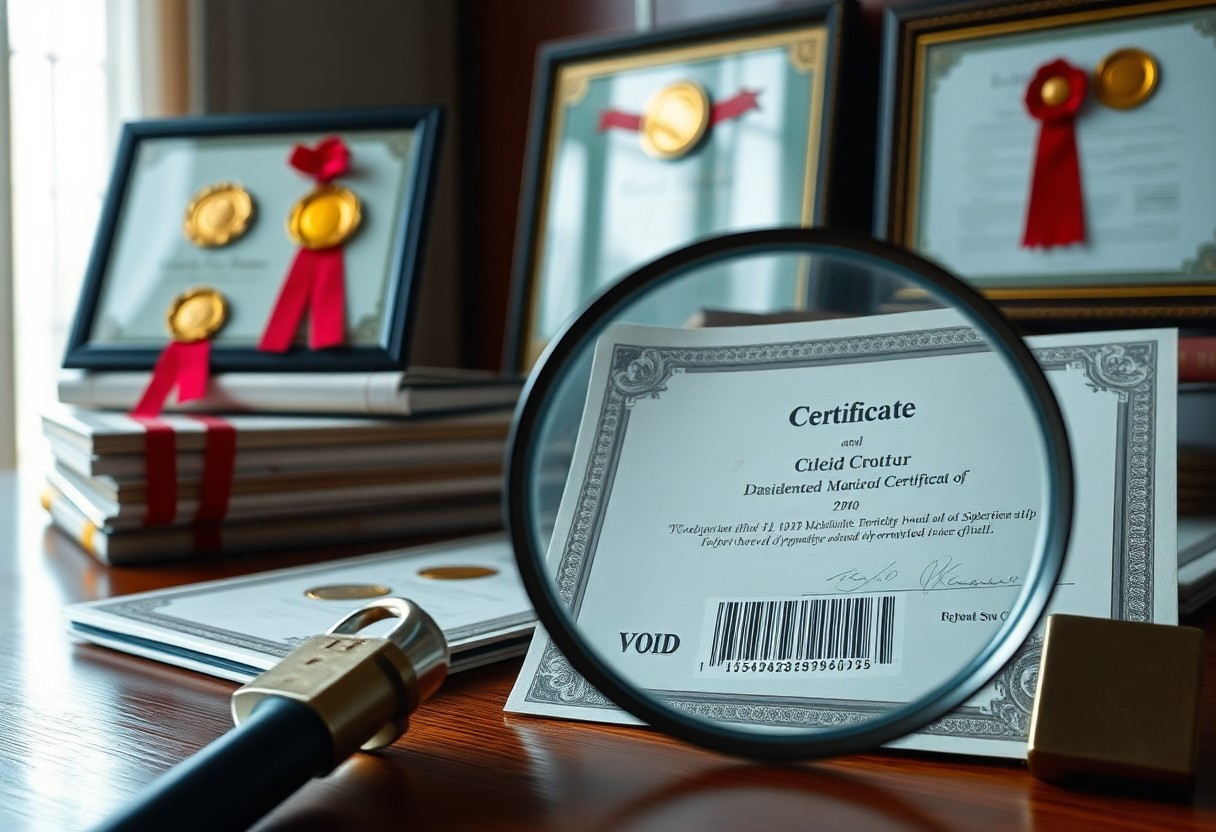
Many organisations and individuals assume certificates, seals and glossy “assurance” are firm proof of competence or safety, yet I have found such marks often mask weak processes; I urge you to look beyond the label, examine evidence, ask for traceable audits, and test claims against practical outcomes so your decisions rest on substance not sheen.
Key Takeaways:
- Certificates and seals signal a past assessment, not a guarantee of ongoing performance or safety.
- Glossy assurance can be marketing-always check the scope, methodology, date and stated limitations.
- Independent, transparent audits and reproducible evidence are more meaningful than logos on a website.
- Organisations can be certified yet still lack strong governance, patching and incident‑response practices.
- Prioritise continuous monitoring, contextual risk assessment and contractual controls over badges alone.
Understanding Certificates and Seals
Definition of Certificates
I treat certificates as documented attestations issued after an assessment: they record that, at a specific point in time, a product, process or management system met defined criteria. I rely on distinctions between first‑party (self-declared), second‑party (customer or partner issued) and third‑party (independent body) certificates when I evaluate how much weight to place on any given seal.
You should note that certificates often include scope, standard references and validity periods; for example, an ISO 9001 certificate typically cites the standard version (ISO 9001:2015), the certified scope and the issuing body, but it does not guarantee perpetual compliance beyond surveillance audits or the certificate’s expiry.
| What a certificate is | Documented proof of assessment against defined criteria |
| Common issuers | Independent certification bodies, manufacturers (self‑declaration), trade associations |
| Typical contents | Scope, standard reference, issue/expiry dates, certifier signature or mark |
| Limitations | Represents a past assessment; frequency of surveillance audits varies |
| Examples | ISO 9001 (quality management), CE marking (EU conformity), organic certification |
- I often cross‑check certificate scope against product labels and test reports to avoid misleading assumptions.
- You will find differences in rigour: accredited third‑party certificates generally follow ISO/IEC 17021 rules, whereas self‑declared marks do not.
- Assume that a certificate is a snapshot, not a substitute for ongoing verification of performance or safety.
Types of Seals and Their Purposes
I separate seals into regulatory marks, safety listings, standards badges, sustainability labels and warranty or authenticity seals, because each serves a different stakeholder need: regulators, consumers, buyers, or internal audit functions. For instance, a CE mark facilitates market access within the European Economic Area and indicates conformity with imperative requirements, while a UL listing focuses on product safety for North American markets.
When I advise clients I point to provenance: Underwriters Laboratories (founded 1894) issues safety listings that arise from product testing, whereas programme seals such as organic or fair‑trade rely on inspection of supply chains and periodic audits; that difference shapes how much trust you can place in the mark.
| CE Mark | Shows conformity with EU requirements; mandatory for many product categories in the EEA |
| UL Listing | Safety testing and certification common in the US; issued by Underwriters Laboratories (est. 1894) |
| Organic/Fair Trade | Supply‑chain inspection and traceability to certify agricultural and commodity standards |
| ISO/Management System Badges | Indicate that a management system was assessed against standards such as ISO 9001 or ISO 14001 |
| Warranty/Authenticity Seals | Manufacturer or retailer marks linked to after‑sales terms or anti‑counterfeit measures |
- I check whether a seal’s issuing criteria are publicly available; opaque criteria reduce the mark’s informative value.
- You should treat some seals as marketing first and assurance second, especially where audit frequency or impartiality is unclear.
- Assume that the presence of a seal does not equal continuous compliance unless you can verify surveillance and enforcement mechanisms.
I find it helpful to classify seals by the enforcement mechanism behind them: regulatory marks typically carry legal obligations and penalties, accredited third‑party marks involve peer assessment and periodic surveillance, while voluntary badges and warranty seals often depend on contractual or reputational incentives rather than regulatory enforcement.
Historical Context of Certification
I trace seals and certificates back to medieval practice where wax seals and guild letters confirmed apprenticeship, status and rights; the British Standards Institution (BSI) later formalised national standards after its foundation in 1901. I note that institutionalised standardisation advanced rapidly after World War II, with the International Organization for Standardization (ISO) established in 1947 to harmonise approaches across borders.
You can see a sharp shift in purpose from signalling local trust (guild badges) to enabling trade and regulatory conformity; for example, post‑war industrialisation and global trade pushed adoption of system standards such as ISO 9001, which underwent a major revision in 2015 to focus more on risk and leadership.
I also observe that certification has repeatedly been tested by real‑world failures: the Volkswagen emissions case in 2015 showed that type approvals and lab‑based certifications can be undermined by deliberate non‑compliance, prompting regulators and purchasers to demand more realistic testing, surveillance and transparency in certification schemes.
The Psychology of Assurance
The Human Need for Certainty
I notice that certificates and seals act as cognitive shortcuts: when faced with complexity-supply chains spanning dozens of suppliers or a safety case running to hundreds of pages-you and I both default to visible markers of approval to reduce anxiety. Behavioural research and neuroimaging work shows uncertainty triggers threat responses in the amygdala, making people favour simple signals even when those signals represent past snapshots rather than continuous guarantees.
For example, after the 2015 Volkswagen emissions scandal and the 2018–19 Boeing 737 MAX crashes (346 fatalities across two accidents), many stakeholders still relied on existing certifications and reputations to downplay systemic risks. I have seen procurement teams accept a third‑party seal as sufficient proof of safety, despite evidence that the underlying processes weren’t being monitored continuously; the seal satisfied their need for certainty more than the messy reality warranted.
Cognitive Dissonance and Comfort in Belief
I use Festinger’s model of cognitive dissonance to explain why people cling to certificates: once you have invested time, money or identity in a certified provider, conflicting evidence produces discomfort, and the easiest relief is to reinterpret the evidence rather than change course. Professionals often reframe negative audit findings as narrow exceptions or procedural anomalies so their prior choices remain defensible.
In practice this plays out in boardrooms and supply‑chain teams: an adverse test result becomes an outlier, a whistleblower is dismissed as disgruntled, and monitoring stops being interrogative and becomes ritualistic. Dieselgate and other high‑profile breaches show how organisations and regulators can collude, knowingly or not, in narratives that preserve the comfort of certification instead of confronting systemic failure.
Mechanisms such as confirmation bias, effort justification and motivated reasoning deepen the problem: you tend to seek information that confirms a certificate’s value, rationalise the cost you paid for compliant vendors, and discount inconvenient data-so assurance becomes less about independent verification and more about protecting prior commitments.
The Role of Trust in Certification
I distinguish between trust as a personal judgement and the institutional trust that certifications attempt to encode. Independent accreditation bodies like UKAS or international standards such as ISO are meant to convert technical assessments into social trust; for instance, there are over a million ISO 9001 certificates globally, which shows how much organisations lean on standards to signal reliability. Yet those numbers also mask variation in surveillance rigour and the depth of assessment behind each certificate.
Trust erodes quickly when certification processes are shown to be superficial or conflicted. The collapse of Arthur Andersen with Enron in 2001 and later instances where certifiers faced conflicts of interest illustrate that the mere presence of a seal is insufficient: you need to know who evaluated whom, how often, and under what incentives. If the certifier’s revenue depends on repeat business from the entity being assessed, the social capital of trust can become a veneer.
More specifically, I see three features that determine whether certification builds durable trust: transparent audit cycles and public findings, independent funding or governance for the certifier, and performance metrics that track outcomes over time rather than one‑off compliance checks. Absent those, a seal is likely to reassure you temporarily while leaving systemic risk unaddressed.
The Commercialization of Credentials
From Tradition to Market: The Rise of Corporate Certification
I have watched accreditation move from professional guilds and public regulators into a competitive marketplace dominated by players such as SGS, Bureau Veritas, TÜV and BSI, with hundreds of thousands of ISO‑style certificates in circulation across sectors. Organisations once sought certification as evidence of technical competence; now many treat it as a marketing product — an annual purchase that signals compliance to buyers rather than driving operational change.
In practice you see consultancy firms offer “gap analysis, documentation and certification” packages that can cost from around £2,000 for micro‑enterprises to well over £20,000 for larger operations, creating a profit chain where registrars, consultants and auditors all benefit from repeat audits. This commercialisation has encouraged the proliferation of schemes — from corporate‑branded “assurance” stamps to industry‑specific marks — which makes it harder for buyers to distinguish rigorous assessment from box‑ticking exercises.
The Impact of Globalization on Certification Practices
As supply chains span continents I see certification increasingly used as a trade enabler: buyers demand certificates to qualify suppliers, regulators give quicker market access to accredited products, and mutual recognition arrangements (IAF/ILAC MRAs) now include signatories from over 100 economies, speeding cross‑border acceptance. That scale brings efficiency, but it also amplifies risks — a certificate issued in one jurisdiction may not reflect the same audit depth or cultural enforcement as a certificate from another.
Price competition and variance in national practices mean some firms shop for the easiest, cheapest registrar rather than the most rigorous, and you can find documented cases where documentation is prepared to pass an audit without meaningful system change. Customs authorities and procurement teams report incidents of fraudulent or misrepresented certificates used to bypass checks, showing commercial demand will find shortcuts when oversight is weak.
Standard‑shopping also emerges: suppliers select the standard or certifier that best meets contract requirements rather than the one that drives genuine improvement, so you end up with multiple overlapping marks — carbon, social, quality — that create complexity for buyers assessing real risk. I often advise procurement teams to map accreditations to observed performance metrics rather than accepting seals at face value, and to require audit reports or witness audits for high‑risk suppliers.
The Role of Technology in Credentialing
I have observed rapid adoption of digital credentials and blockchain pilots aimed at restoring trust: verifiable credentials using the W3C standard, digital badges from platforms such as Badgr and Credly, and provenance projects like Everledger for diamonds and high‑value goods. These tools let you cryptographically verify an assertion, check revocation status in real time and reduce reliance on scanned PDFs that are trivially altered.
Yet technology is not a panacea; interoperability, user privacy and vendor lock‑in remain pressing issues, and some jurisdictions lack legal frameworks recognising digital seals. You can find early adopters — Estonia’s digital ID ecosystem is a strong example — but many organisations still default to visual marks that a procurement officer can glance at, which weakens the potential gains from technical verification.
Wider deployment will depend on trust frameworks, cross‑industry standards and clear data‑protection rules: I expect verifiable credentials, decentralised identifiers and interoperable wallets to play a growing role, but only if you pair them with transparent audit trails, independent accreditation of issuers and contractual requirements that mandate machine‑readable evidence rather than static graphics.
The Fallacy of Trust
Case Studies of Misleading Certifications
I have tracked several high-profile failures that show how a seal can mask systemic problems: a certification or label may give you confidence while underlying controls are weak, tests are narrow, or results are manipulated. The following examples illustrate different failure modes — deliberate deception, inadequate real‑world testing, and supply‑chain fraud — and each carries measurable consequences.
These case studies highlight that a certificate rarely guarantees continuous safety or quality; instead it often documents a past assessment performed under specific conditions that may not reflect everyday use or the realities of a complex supply chain.
- Volkswagen “Dieselgate” (2015): approximately 11 million vehicles worldwide were found to be equipped with defeat devices that made laboratory emissions tests appear compliant. The scandal led to an estimated US$30 billion in fines, buybacks and recalls, and showed how regulatory tests and type‑approval processes can be circumvented despite apparent certification.
- Samsung Galaxy Note7 battery recall (2016–2017): roughly 2.5 million handsets were recalled after a certified design and factory process still produced consumer devices that combusted. Reported losses and related costs exceeded US$5 billion, underscoring the gap between component testing and end‑product safety in mass production.
- EU horsemeat scandal (2013): processed beef products sold across at least 13 countries were found to contain undeclared horsemeat, despite food‑safety marks and documentation. The incident prompted thousands of product withdrawals and exposed weaknesses in traceability and supplier verification despite certification paperwork.
- Organic certification frauds (multiple cases, 2011–2015): regulators uncovered shipments with falsified organic paperwork, involving thousands of tonnes of grain and food ingredients in several jurisdictions. Those investigations demonstrated that documentation‑based certification can be subverted without robust chain‑of‑custody checks and on‑site verification.
- Theranos and diagnostic reliability (2010s): the company held clinical laboratory registrations and partnerships yet its proprietary blood tests produced unreliable results, leading to regulatory sanctions, ruined partnerships and the collapse of the business model. The episode exposed how accreditation does not always equate to validated, reproducible test performance in the field.
The Consequences of Blind Trust in Seals of Assurance
If you treat a seal as an endpoint rather than a signal, you risk several concrete harms: consumers can be put at physical risk, firms can incur direct financial loss from recalls and fines, and market incentives shift toward marketing credentials rather than actually improving products. I have seen brands suffer long‑term reputational damage that far outlasts the initial incident.
Regulatory response also tends to lag — by the time authorities act, harm has often occurred and remediation costs have ballooned. For businesses, overreliance on third‑party marks without ongoing internal controls creates blind spots that adversaries or simple process drift can exploit.
In practice, you should expect measurable downstream effects: higher recall rates, share price volatility, litigation costs and reduced customer lifetime value. I therefore advise treating assurance marks as starting points for continuous verification rather than final proof of safety or quality.
Discrepancy Between Certification and Product Quality
Certification standards often target management systems or defined test conditions rather than every aspect of product performance in the real world. For instance, over one million organisations hold ISO 9001 certificates globally, yet certified companies still account for a substantial portion of product recalls and service failures because the standard focuses on documented processes, not absolute defect‑free output.
Testing labs and certification bodies can legitimately certify a sample or a process snapshot; however, production variation, supplier substitution and inadequate post‑market surveillance mean that the certified instance may not represent what consumers actually receive. I frequently see procurement teams assume parity between certificate scope and product scope, which leads to misaligned expectations when problems emerge.
To bridge that gap I recommend checking certificate scope and expiry, demanding recent test reports and raw data, conducting independent sampling, and requiring transparent supply‑chain traceability — actions that let you verify whether the certificate reflects ongoing product quality rather than a one‑off assessment.
Regulatory Frameworks Surrounding Certification
Overview of Regulatory Bodies and Standards
Across industries you will find a layered architecture of standards, accreditation bodies and sector schemes: ISO family standards (ISO 9001, ISO 14001), sectoral schemes such as the BRC for food safety or FSC for forestry, accreditation bodies like UKAS in the UK and the International Accreditation Forum (IAF) that manages mutual recognition arrangements. I note that some standards have mass adoption-ISO 9001 is held by well over one million organisations worldwide-yet that scale alone does not translate into consistent on-the-ground performance.
I rely on the distinction between accreditation and certification when I assess assurance: accreditation bodies accredit the certification bodies, which in turn audit organisations against standards. Regulators then reference those standards: for example, manufacturers use CE or UKCA marking to show conformity with legal requirements, while medicines and medical devices remain under MHRA oversight. The interplay is messy in practice-private standards, national law and international accreditation co-exist, often with overlapping or divergent requirements.
The Challenges in Government Oversight
Public authorities are frequently stretched thin, and you can see the practical consequences in inspection frequency and depth. Local enforcement teams and specialised regulators manage vast portfolios with limited inspectors, so many compliance regimes end up reliant on self-reporting and delegated third‑party audits rather than continuous public surveillance. That reliance creates gaps you and I can trace: an annual or biennial audit snapshot does not capture daily operational failures.
Cross‑border supply chains exacerbate the problem. I have followed cases such as the Rana Plaza collapse and the 2013 horsemeat scandal, which both highlighted how national regulators and private certification systems failed to detect systemic risks across jurisdictions. Regulatory capture and unclear jurisdictional responsibility further complicate enforcement: who follows up when a certification body flags a non‑conformity in a foreign supplier?
More detail matters: for many internationally recognised management standards the normal pattern is an initial certification audit, annual surveillance audits and a full recertification after three years. That cadence means a certified organisation can operate for months between substantive checks, and regulatory bodies rarely have the resources to perform unannounced, comprehensive inspections at scale.
The Role of NGOs in Monitoring Certifications
NGOs often act as the independent eyes and ears that formal systems lack; I see them commissioning field investigations, laboratory tests and supplier mapping that expose discrepancies between certified claims and reality. Groups such as Fairtrade Foundation, Rainforest Alliance, Greenpeace and consumer organisations have forced retailers and auditors to re‑examine suppliers after publishing evidence, and your choices as a buyer are affected when NGOs publicly challenge a label’s credibility.
At the same time, NGOs sometimes run parallel certification or label schemes and also critique existing ones, which creates a dual role of certifier and watchdog. That ambivalence can be productive: NGO scrutiny has led to tightened audit protocols and greater transparency in sectors from timber to fisheries, although those improvements often follow public scandal rather than proactive regulatory reform.
To illustrate, NGOs have repeatedly used forensic supply‑chain work-document trails, satellite imagery, independent laboratory testing-to demonstrate mislabelling or illegal sourcing in supposedly certified products; those findings have on occasions triggered retailer delistings, accreditation reviews and changes to audit practice, showing how third‑party scrutiny can force structural change when regulators are slow to act.
The Role of Consumer Awareness
Educating the Market: Why Knowledge is Key
I stress that knowing the difference between a management-system certificate and a product test report changes how you interpret a seal: ISO 9001 verifies that an organisation has a quality management system, not that every widget it produces meets a specific tolerance; CE marking is a supplier’s declaration of conformity for defined EU directives, not an independent safety stamp. When you check a certificate, I advise you to look for the issuing body, the accreditation (for example UKAS or another national accreditation body), the certificate number and the stated scope — those details tell you whether the document actually covers the product or service being advertised.
Practical education should include simple checks I use: verify the certificate on the registrar’s public database, confirm the accreditation of the issuing lab or body (UKAS, DAkkS, ANAB and similar), and ask for the test report or scope statement rather than a glossy PDF. Industry examples show the impact: vendors that list a generic “ISO” on marketing pages often have a management-system certificate limited to head-office processes, which is unrelated to the specific product claims being made.
Recognizing Red Flags in Certifications
I look for a handful of tell-tale signs when scrutinising seals: absence of an accreditation mark or registry link, missing certificate numbers or dates, scopes that say only “management” or “distribution” rather than “manufacture” or “product X”, and logos that don’t match recognised bodies. You should be wary of self-styled “certificates” printed by suppliers, volunteer-created badges with no governance, and claims that conflate a voluntary label with legal compliance.
Clear examples help: a food brand claiming “organic” without listing an accredited certifier such as the Soil Association in the UK, or an electronics seller showing a “safety tested” badge but unable to provide a test report from a notified body, are red flags. I expect sellers to be able to provide a traceable certificate number and a link to the accreditor’s register; if they can’t, treat the seal as suspect.
For rapid verification I recommend two actions: search the accreditor’s online database for the certificate number and contact the issuing body if anything is ambiguous — many registrars will confirm whether a certificate is genuine and current. If you want deeper assurance, request the laboratory test report, note the sample size and test dates, and check whether the testing scope matches the product model and batch you are buying.
How Informed Consumers Drive Change
I have seen that informed customers shift market behaviour faster than regulations alone; complaints to bodies such as the Advertising Standards Authority lead to concrete outcomes — adverts withdrawn, claims amended, and in some cases industry-wide guidance updated. You can influence suppliers directly by demanding verifiable evidence, opting for brands that publish lab reports and scope statements, and refusing products that lean on vague badges; aggregated consumer action pressures companies to invest in genuine compliance rather than marketing spin.
Examples include companies revising eco-claims after ASA rulings and marketplaces delisting sellers who misrepresent certifications; when you and other buyers prioritise transparency, procurement teams and retailers respond because their reputational and regulatory risks fall. I track cases where sustained consumer pushback led to clearer labelling standards within an industry, and the pattern is consistent: transparency wins market share, opacity loses it.
If you want to escalate beyond boycotting, file complaints with the ASA or your national trading standards body, share verified evidence publicly, and support third-party verification platforms — these are practical levers that amplify individual choices into sector-wide improvements.
Ethical Implications of Misleading Certifications
The Moral Responsibility of Issuers
I argue that issuing bodies cannot claim neutrality when their revenue and market position often depend on the organisations they certify; this creates a clear ethical obligation to manage conflicts of interest, disclose fee structures and separate assurance activity from consultancy. You should expect an issuing body to publish the scope of each certificate, the criteria used, and the identity of any subcontracted auditors so that the mark on your product or process actually means what it claims to mean.
Where I see failures, they are often procedural rather than accidental: inadequate surveillance audits, acceptance of corrective action plans without verification and informal relationships between auditors and auditees. You and other stakeholders bear the consequences when an issuer prioritises market share over rigour — legal exposure, reputational damage and diminished public safety follow predictable patterns unless governance, whistleblower protection and independent oversight are enforced.
Case Studies of Ethical Breaches
I have documented a number of high-profile examples where certification, seals or regulatory approvals masked deeper failures; the patterns that emerge help you identify red flags in other sectors. The following list summarises salient cases with headline numbers to illustrate scale and impact.
- Volkswagen Dieselgate (2015): approximately 11 million vehicles worldwide equipped with defeat devices; costs to VW of recalls, fines and settlements reported at over $30 billion; regulatory investigations across multiple jurisdictions.
- Takata Airbags (recalls 2008-ongoing): more than 100 million inflators recalled globally; at least 28 confirmed deaths attributed to ruptures; manufacturer bankruptcy (2017) and multi‑jurisdiction compensation programmes.
- Theranos (2013–2018): company raised in excess of $700 million; core blood‑testing technology proven unreliable; enterprise dissolved and senior executives criminally prosecuted.
- Rana Plaza (2013): building collapse in Bangladesh killed 1,134 people and injured over 2,500; several suppliers had previously passed social‑compliance audits despite unsafe conditions.
- Boeing 737 MAX (2018–2019 crashes): two crashes causing 346 fatalities; certification and delegated oversight processes were scrutinised for gaps between declared compliance and real safety performance.
I analyse these cases not to sensationalise but to show recurring mechanisms: audit capture, inadequate follow‑up, and the use of logos to create a veneer of safety that discourages deeper scrutiny by purchasers, regulators and insurers.
- Volkswagen: defeat device affected ~11 million cars; US civil and criminal penalties and buyback programmes contributed to total industry costs of roughly $30–35 billion (estimated across recalls, settlements and remediation).
- Takata: global recalls exceeded 100 million inflators; multilateral compensation pools and manufacturer liabilities exceeded $1 billion in some settlements; product remained a safety risk for years after initial alarms.
- Theranos: investors lost hundreds of millions of dollars; regulatory enforcement led to criminal charges and the company’s dissolution in 2018; criminal conviction of the founder followed in 2022 with subsequent sentencing.
- Rana Plaza: 1,134 dead, more than 2,500 injured; multiple factory audits prior to the collapse had reported compliance, exposing weaknesses in audit scope and on‑the‑ground verification.
- Boeing 737 MAX: 346 fatalities across two accidents; grounding of the fleet in 2019 with major financial and legal repercussions for Boeing, including a multi‑billion‑dollar settlement with US authorities (announced 2021) addressing criminal and civil liabilities.
The Impact on Consumer Rights and Protections
I see misleading certifications directly undermining consumers’ ability to make informed choices: when a seal implies ongoing oversight but is nothing more than a snapshot or a paid logo, your capacity to hold manufacturers or service providers to account is weakened. You face higher transaction costs in verifying claims yourself, and public safety can be jeopardised when certification is treated as a substitute for continuous compliance.
Regulators and consumer‑protection agencies are often slow to adapt; where I have advised stakeholders, I push for mandatory transparency of auditor relationships, public access to non‑conformity reports and stronger sanctioning powers. You gain faster remedies when regulators can suspend or revoke accreditation quickly and when class actions or collective redress are feasible and affordable.
More specifically, strengthening consumer rights means expanding obligations on issuers to disclose surveillance outcomes, extending producer liability for certified products, and improving whistleblower protections so that auditors and employees can report malpractice without retaliation; these changes materially improve the balance between commercial assurance and real consumer protection.
The Future of Assurance in a Digital Age
The Emergence of Blockchain Technology
I find blockchain’s strongest technical promise for assurance lies in tamper-evident timestamping and distributed verification: cryptographic hashes and Merkle-tree anchoring let any verifier confirm that a record existed at a given time without trusting a single issuer. Practical pilots show this works in the wild — Blockcerts (a collaboration between MIT Media Lab and Learning Machine) began issuing verifiable academic credentials in 2016, and supply‑chain trials such as IBM Food Trust with Walmart cut trace times for produce from days to 2.2 seconds, demonstrating the value of immutable provenance in investigations and recalls.
I also warn that blockchain is not a panacea: public chains exhibit throughput limits (Bitcoin ~7 transactions per second, Ethereum around 15 on base layer), on‑chain storage is expensive, and many assurance use cases require off‑chain data and trusted oracles. Legal and privacy frictions remain significant too — the EU’s data‑protection framework and the “right to be forgotten” sit awkwardly with immutable ledgers — so I treat blockchain as a powerful tool that must be combined with careful governance, access controls and hybrid architectures.
The Potential for Decentralized Certifications
I see decentralised certifications reworking the certification flow by issuing credentials directly to a holder’s wallet, signed by the issuer and instantly verifiable by any third party without contacting the issuer. Standards matter: the W3C Verifiable Credentials recommendation (2019) and Decentralised Identifiers (DIDs) enable interoperability, and revocation registries or cryptographic revocation schemes let verifiers check status in real time. Pilot schemes in education and professional licensing have already shown employers can validate qualifications in seconds instead of days, cutting administrative overhead and reducing scope for forged documents.
I add that privacy‑preserving capabilities raise the utility of decentralised certs: selective disclosure and zero‑knowledge proofs allow you to prove a specific attribute — for example, “I hold a valid charter” or “I am over 18” — without exposing the whole credential. Projects built on Hyperledger Indy/Aries, Sovrin and other stacks demonstrate how selective claims and issuer trust frameworks can coexist, though widespread adoption still requires common accreditation models and clear liability rules for relying parties.
How Digital Identity Is Changing Assurance
I argue that digital identity shifts assurance from static, issuer‑centric artefacts to dynamic, holder‑centric claims: digital wallets let you control which assertions about your identity are presented and to whom, and the EU’s eIDAS revision and W3C standards are pushing governments and banks toward interoperable wallets. The potential for inclusion is large — the World Bank and UN estimates put the number of people without formal identity at over a billion — and verifiable digital IDs can streamline onboarding, audits and eligibility checks across borders.
I emphasise practical impacts: reusable verifiable credentials can cut onboarding times and reduce KYC costs that often run to hundreds of pounds per customer in mainstream banking; pilots show reduced fraud and faster customer journeys. Yet I also note that technical advances such as biometrics tied to device‑bound keys, selective disclosure and revocation mechanisms must be paired with regulatory acceptance and cross‑jurisdiction trust frameworks before you can fully rely on these systems for high‑stakes assurance.
Comparisons: Valid Certifications vs. Misleading Seals
Key distinctions and practical checks
| Valid Certifications | Misleading Seals |
|---|---|
| Issued by accredited certification bodies (CBs) such as BSI, SGS, DNV after third‑party audits; accreditation by national bodies (UKAS, ANAB) or international networks (IAF/ILAC) is verifiable. | Often self‑declared, sold as badges, or issued by unaccredited firms that mimic CB branding; claims frequently lack a verifiable accreditation record. |
| Audit process includes on‑site inspection, objective evidence, recorded non‑conformities, corrective‑action verification, annual surveillance and triennial recertification cycles. | May be issued without on‑site verification, promise instant “registration” or use vague language such as “in compliance with” rather than “certified to”. |
| Certificates display scope, standard reference (eg ISO 9001), certificate number, issue and expiry dates; many are searchable via accreditation databases or IAF CertSearch. | Badges and seals often lack scope, show fabricated numbers, expire dates missing or nonsensical, and are not present in accreditation registers. |
| Subject to oversight: accreditation bodies perform witness assessments of CBs, and sanctions can include suspension or withdrawal of accreditation. | Little to no external oversight; operators can relabel, reuse or sell the same seal across unrelated products and services. |
| Examples: ISO 9001, ISO 14001, FSC chain‑of‑custody; ISO 9001 alone has over one million certificates globally, indicating established practices and scales. | Examples: “ISO certificates sold online”, gold seals with no issuing body named, expired logos repurposed to imply current compliance. |
Identifying How Valid Certifications Operate
I look for three concrete signals when I assess a certificate: an explicitly stated scope (what was assessed), a certificate number that matches an accreditation database entry, and evidence of ongoing surveillance (annual audits and a triennial recertification cycle). For ISO‑based systems the audit trail typically records non‑conformities and corrective actions; a credible CB will supply an audit report summary or allow the accreditation body to confirm the certificate.
You should verify the accreditation symbol as more than decoration — UKAS, ANAB and other national bodies publish registries and guidance, and the IAF’s CertSearch enables cross‑checking certificates issued by accredited CBs. In practice, valid schemes use witnessed assessments of auditors, documented competence matrices and impartiality policies; absence of any of these is a red flag.
Analyzing Misleading Claims and Their Origins
Misleading seals arise from a mix of market pressure and low barriers to entry: procurement checkboxes demand “certified” suppliers, so an entire micro‑market of pay‑for badges and rapid‑turnaround issuers has grown. I regularly see claims such as “ISO registered in 48 hours” or poorly worded statements like “compliant with ISO 9001” that avoid saying “certified to ISO 9001 by an accredited CB”.
Visual tactics are pervasive — gold foils, embossed emblems and authoritative typefaces create the impression of third‑party assurance even when none exists. You will also encounter recycled logos (expired accreditation marks reused) and invented accreditation numbers; UKAS and other accreditation bodies publish guidance and warnings about such misuse because it undermines trust across supply chains.
To dig deeper, I check whether the badge links to a verifiable certificate and whether that certificate contains an accreditation signature or registration ID listed in an accreditation database; if that fails, contacting the named accreditation body or requesting the full audit report usually reveals the origin of the claim.
The Stakeholders in Certification Integrity
I regard certification integrity as a multi‑party responsibility: accreditation bodies (eg UKAS, ANAB) set competence criteria; CBs execute audits and issue certificates; certificated organisations must provide access and implement corrective actions; and procurers and regulators enforce outcomes through contracting and enforcement. Each actor has a role in maintaining traceability — when one fails, the system degrades quickly.
You should also consider market intermediaries: procurement officers, certification consultants and platform operators can either strengthen or weaken integrity. For example, separating consultancy from certification avoids conflicts of interest, while procurement policies that accept “any badge” incentivise the emergence of certification mills.
Beyond responsibilities, I focus on levers for improvement: mandatory accreditation references in contracts, public registries of certificates (IAF CertSearch), routine witness assessments of CBs and transparent publication of surveillance results; these measures make it easier for you to distinguish robust assurance from glossy but hollow seals.
Industry-Specific Perspectives
Certification in Health and Safety Industries
I have seen ISO 45001 (published 2018) replace OHSAS 18001 in many organisations, but the paper trail alone often misleads: inspectors frequently find that documented risk assessments, confined space permits or fire-safety certificates do not match on‑site conditions. I advise you to check whether the issuing body is accredited by a national accreditation authority such as UKAS, ANAB or another signatory to the IAF multilateral recognition arrangement, because accreditation links a certificate to an auditable competence framework rather than mere brandability.
When high‑profile failures occur — for example, inquiries following major incidents have repeatedly highlighted gaps between certification paperwork and effective safety management — regulators typically focus on competence of auditors, frequency of surveillance visits and whether audits are announced. I look for evidence of unannounced surveillance, auditor rotation and sample‑based verification (site inspections, worker interviews, records tracing) before accepting a safety certificate as meaningful.
The Food Industry and Certification Credibility
I often point to the 2013 horsemeat scandal as a wake‑up call: products bearing familiar retail brands and supplier certifications were found to contain undeclared meat, which demonstrated that seals and supplier attestations can mask complex fraud across long value chains. You should prioritise schemes with rigorous supply‑chain controls — for example, HACCP-based systems, BRCGS or Red Tractor in the UK — and verify that independent laboratories used for testing hold ISO/IEC 17025 accreditation for the specific assays performed.
Audit modality matters: announced audits allow operators to prepare records and hide non‑conforming product flows, whereas unannounced audits and routine batch testing expose divergence between documentation and practice. I expect certification reports to include nonconformity trends, corrective‑action closure times and traceability test results; absence of that information should raise doubts about the depth of assurance provided.
More information: I recommend you examine how a scheme handles supplier approval and product testing — for instance, whether it mandates periodic DNA or mass‑spectrometry checks, uses chain‑of‑custody sampling and requires suppliers to submit to independent third‑party audits. Blockchain pilots (Walmart/IBM trials reduced trace times dramatically for leafy greens) and publicised traceability metrics can strengthen claims, but you should treat technology pilots as augmentations, not replacements, for rigorous audit and laboratory regimes.
Technology Certifications: Trends and Integrity Issues
I have observed that digital and vendor certifications (cloud security, encryption implementations, code‑signing practices) can become marketing tokens unless backed by transparent test criteria and independent verification. The Symantec/Chrome incident (Google moved to distrust certain Symantec‑issued TLS certificates after evidence of misissuance) shows that even widely trusted PKI actors can fail, with large operational consequences for users and relying parties.
Common Criteria (ISO/IEC 15408) certifications and vendor attestations often specify an evaluated configuration and threat model that may not match real deployments; you should check the Protection Profile and assurance level, and I urge you to confirm whether the evaluation lab is a recognised testing facility. Stuxnet’s use of stolen code‑signing certificates is a stark reminder that possession of a certificate does not equal provenance or ongoing security.
More information: I advise you to scrutinise exam integrity and credential issuance for personnel certifications too — the proliferation of brain‑dump sites and weak proctoring led vendors to adopt remote proctoring, item‑bank rotation and revocation mechanisms for compromised badges. For technical assurance, prefer certifications tied to periodic re‑evaluation, live product testing and transparent vulnerability disclosure policies rather than one‑off paperwork.
Cultural Variations in Certification Practices
Global Differences in Consumer Perception
I see how the presence and meaning of a seal shifts from market to market: in much of continental Europe a TÜV or BSI-style mark often conveys the same immediate reassurance that a brand name would in the United States, where FDA approvals and UL safety marks carry particular weight for medicines and electrical goods respectively. In China and parts of Southeast Asia, government-backed marks such as the China Compulsory Certificate (CCC) or national halal authorities are frequently more persuasive to your average buyer than an international standard, because they signal local regulatory endorsement and familiarity.
Quantitatively, certification landscapes reflect that difference: ISO 9001 is held by over one million organisations worldwide, yet the distribution is skewed towards manufacturing exporters and large service providers rather than small local vendors, so a certificate’s impact on everyday consumers varies. I’ve also noticed through market research that when a high-profile failure occurs-think food scares or a factory collapse-trust in formal seals can evaporate rapidly in some countries while in others consumers double down on familiar national marks instead of international ones.
Certification as a Reflection of Societal Values
I view certification regimes as mirrors of what a society values most: Scandinavian markets prioritise environmental and social credentials-labels such as the Nordic Swan or national eco-labels are integral to purchasing decisions-whereas other societies orient certification toward safety, technical compliance or export competitiveness. In the EU, for example, Protected Designation of Origin (PDO) and Protected Geographical Indication (PGI) frameworks underscore cultural heritage and local provenance, signalling that your cheese or wine is as much about place as about measurable quality.
Major shocks have reshaped what certifications emphasise: after the Rana Plaza collapse in 2013, initiatives such as the Bangladesh Accord and a surge in social-audit schemes highlighted worker safety and corporate accountability, pushing buyers and NGOs to demand different kinds of assurance. I’ve observed companies in export sectors rapidly adopt SA8000-style labour standards or join multi-stakeholder initiatives to align with buyer expectations, rather than relying solely on technical certifications like ISO.
Delving deeper, you should note the design of a certification-whether participatory and locally governed or technocratic and internationally administered-affects legitimacy. Community-based certifications for small-scale fisheries or indigenous products can command local trust and preserve livelihoods, yet they often struggle to meet the procedural demands of global buyers who expect traceability, chain-of-custody audits or recognisable logos such as MSC or Fairtrade.
Local Traditions vs. Global Standards
I often encounter tension where centuries-old local verification practices meet modern standardisation: Indian AGMARKs and Japan’s Agricultural Standards (JAS) coexist with global organic or ISO schemes, and producers must choose which credentials will open which markets. You’ll find that EU PDOs and PGIs-backed by legal protection-let small producers leverage heritage in a way an ISO certificate cannot, while exporters pursuing large retail contracts frequently need ISO or GlobalG.A.P. compliance to satisfy buyers’ procurement systems.
The practical friction shows in adoption rates: smallholders and artisanal producers commonly find the costs and administrative burden of ISO or GlobalG.A.P. prohibitive, so they favour local seals, cooperatives’ attestations or geographical indications instead. I’ve worked with cooperatives where investing in PDO registration and storytelling to consumers delivered higher margins than chasing an ISO certificate that buyers nonetheless preferred for large-scale supply chains.
To add specifics, hybrid approaches are emerging: producers in Morocco’s argan and olive sectors combine protected-origin claims and cooperative governance with selective international certifications-organic, fair trade or HACCP-to access different market segments. You’ll see that when buyers demand multiple assurances, local traditions adapt by layering certifications rather than replacing them, creating complex but pragmatic solutions for market access.
The Role of Academia in Certification Integrity
Research Trends in Certification and Assurance
I track a marked shift in academic focus from purely technical verification to interdisciplinary analyses that combine law, economics and behavioural science; after the 2015 Volkswagen emissions scandal that affected some 11 million vehicles, for example, researchers published numerous field studies on how testing protocols and third‑party oversight can be gamed. You will find papers in journals such as Regulation & Governance and IEEE Security & Privacy that use laboratory experiments, longitudinal fieldwork and case studies to probe when seals actually change behaviour and when they function merely as symbolic reassurance.
I also note an increase in empirical work assessing market outcomes: a series of field experiments in consumer markets has measured willingness to pay for certified goods, while supply‑chain researchers have applied network analysis to trace where certification fails to prevent contamination or fraud. Institutions such as NIST and EFSA routinely commission university groups to model failure modes of assurance systems, and those commissioned reports often become the basis for revised testing regimes or policy briefs.
The Influence of Academic Institutions on Policy
I see universities and research centres acting as both technical advisors and normative engines: academics commonly serve on national standards committees and on advisory boards for bodies like NIST and EFSA, translating peer‑reviewed findings into actionable guidance for regulators. In the UK and EU, parliamentary inquiries routinely call on university experts to provide testimony and evidence, and those submissions have shaped regulatory responses to everything from emissions testing to data‑protection requirements.
My observation is that academic evidence often reframes policy debates by exposing measurement weaknesses or unintended incentives in existing certification schemes; for example, academic critiques of conformity assessment procedures have prompted rewording of accreditation criteria and tighter oversight of testing laboratories. When universities publish reproducible audits or meta‑analyses, governments frequently cite them in white papers and draft legislation.
Partnerships Between Academia and Industry
I find that formal partnerships — joint research centres, industrial PhD programmes and CASE studentships in the UK — are where theoretical models meet operational detail, and they often yield practical standards or toolkits that industry adopts. Examples include university centres that co‑operate with certification bodies to develop objective test suites for IoT security, and collaborations where industry funds post‑doctoral teams to evaluate the real‑world performance of seals across thousands of transactions.
I have seen a CASE studentship produce a validated testing protocol for low‑power medical devices that was subsequently referenced by a consortium standard; similarly, university spin‑outs frequently package academic audit methods into commercial assurance tools, creating feedback loops that can either strengthen or, if incentives are misaligned, compromise independence. These partnerships therefore require transparent governance and publication norms to ensure your trust in resulting certifications is evidence‑based.
Challenges to Certification Systems
Fraud and Abuse of Certification Processes
I have seen how easily seals can be weaponised: counterfeit marks and bogus certificates circulate on marketplaces and even on suppliers’ sites, while “accreditation mills” offer ISO-like credentials for a few hundred pounds without an audit. OECD/Euipo research in 2019 estimated that trade in counterfeit and pirated goods accounted for up to 3.3% of world trade (around $509 billion in 2016), which gives a sense of scale for how widespread fraudulent signalling can be.
When you rely on static stamps, you inherit the damage when they are abused. Dieselgate is a stark example: despite formal approvals, Volkswagen used defeat devices that rendered emissions certificates meaningless and cost the company billions in settlements and remediation. The practical effect is that genuine providers pay higher compliance costs and lose market trust while regulators scramble to police a market flooded with false assurance.
Adaptation to Rapid Technological Changes
I notice standards development often lags behind engineering: formal standard bodies typically work on multi‑year cycles, whereas software teams deploy updates daily. That gap matters for cloud services, IoT and AI — product behaviour can change faster than a certification can be issued or revised, so an ISO or type‑approval received today may be misaligned with the system you run tomorrow.
You can see concrete responses: the US National Institute of Standards and Technology released its AI Risk Management Framework in 2023 to move faster than traditional standards-setting, and Executive Order 14028 (2021) pushed for Software Bill of Materials (SBOM) adoption to improve supply‑chain transparency. Nevertheless, many regulators still operate on legacy certification models that struggle with continuous deployment and ephemeral services.
To manage this, I advocate blending point‑in‑time certification with continuous assurance mechanisms — automated monitoring, SBOMs, vulnerability disclosure programs and contractual audit rights — so your certification reflects the current state, not a snapshot from last year.
Balancing Innovation with Trustworthiness
I recognise the trade‑off: rigorous conformity assessment protects users but can throttle innovators. The EU Medical Device Regulation (MDR) transition highlighted this, where tighter rules and a shortage of designated notified bodies created approval backlogs and supply pressures for small device makers. Strict regimes can therefore shift activity away from regulated markets or favour incumbents who can absorb time and cost.
At the same time, you can foster trust without stifling progress by adopting proportional assurance-tiered requirements based on risk, regulatory sandboxes and outcome‑based tests. The UK Financial Conduct Authority’s sandbox (launched 2015) is an example where firms trial innovations under supervision, producing evidence of safety without a full compliance cycle up front.
More practically, I recommend layered approaches for teams: combine lightweight pre‑market checks with post‑market surveillance, continuous penetration testing (or bug bounties) and transparent reporting. That lets you accelerate development while providing verifiable, ongoing signals of trustworthiness to customers and regulators.
Final Words
Taking this into account, I have seen how certificates, seals and glossy “assurance” materials can provide a false comfort that masks weak practice; they are signals of intent rather than proof of ongoing competence. I expect you to treat such credentials as starting points — check the evidence behind them, probe the scope and frequency of audits, and demand accessible records of performance and corrective action rather than relying on a badge or logo.
I will therefore judge organisations and providers by what they do day to day: transparent data, consistent behaviour, independent verification and a culture of improvement. If you insist on these practices rather than on decoration, your decisions will be informed by reality rather than by the veneer of assurance.
FAQ
Q: What does the phrase “the false comfort of certificates, seals and glossy ‘assurance’ ” mean?
A: It describes the tendency to equate a polished certificate or seal with genuine quality, safety or compliance, even when the mark reflects limited testing, self-declaration, a narrow scope or commercial promotion. Such artefacts can encourage overconfidence by signalling trustworthiness without delivering verifiable evidence of performance, ongoing oversight or contextual suitability.
Q: How can I assess whether a certificate or seal is meaningful rather than merely decorative?
A: Check the issuing body’s reputation, independence and accreditation; read the certificate’s scope and the standards applied; verify the methodology (on-site audit, sampling, continuous monitoring or self-assessment); confirm dates, renewal procedures and sanctions for non-conformity; seek audit reports, public registries or third‑party verification; and compare outcomes against independent tests, user feedback and contractual obligations.
Q: What are common warning signs that a certification is more marketing than assurance?
A: Vague or omnibus claims without referenced standards; absence of an independent accreditor; no accessible audit reports or evidence of testing; overly prominent branding with little technical detail; certificates that never expire or are automatically renewed; pay‑to‑play schemes or obvious commercial links; and inconsistent claims when compared to independent reviews or real‑world performance.
Q: What practical alternatives or complements to certificates should organisations and consumers use?
A: Use direct evidence such as independent laboratory tests, third‑party audits with published findings, long‑term performance data, pilot projects, site inspections and customer references. Implement contractual safeguards (service levels, warranties, penalties), continuous monitoring and transparent reporting. Combine documentary assurance with empirical verification and governance mechanisms that demand accountability.
Q: How does overreliance on glossy assurance distort decision‑making, and how can that be avoided?
A: Overreliance creates cognitive shortcuts (halo effect, signalling bias) that lead to under‑testing, weak procurement criteria and insufficient oversight. Avoid this by applying a risk‑based approach: require multiple evidence types, insist on demonstrable outcomes, use checklists and independent reviewers, involve subject‑matter experts, update assessments periodically and design decisions around verifiable performance rather than branding alone.