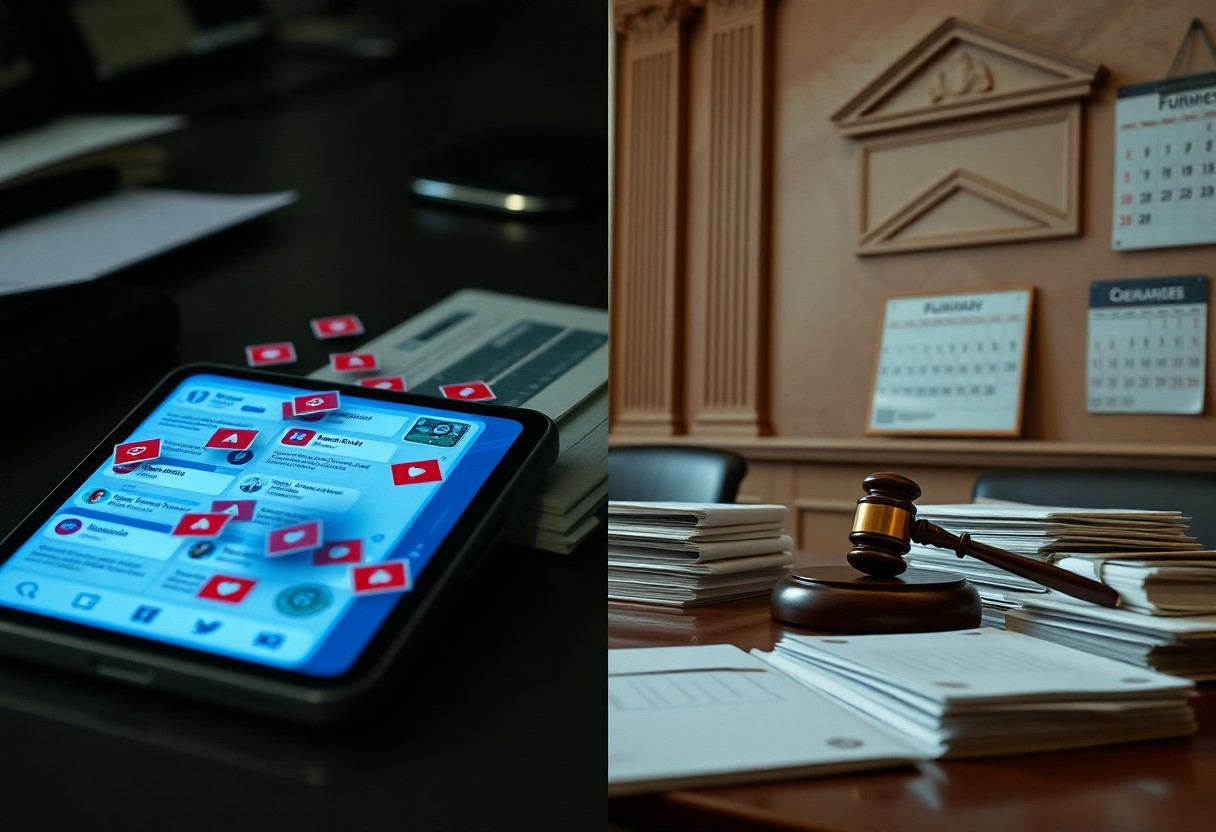
Most organisations underestimate how quickly reputational harm spreads compared with the slow churn of legal procedure. I draw on case studies and data to explain how social media amplification, round-the-clock news and global networks outpace court timetables, so you can prioritise timely communications, rapid fact-gathering and board-level preparedness to protect your reputation while legal remedies progress.
Key Takeaways:
- Instantaneous reach of social media and a 24/7 news cycle means allegations can become widely known long before legal processes conclude.
- Low barriers to publishing and sharing allow unverified claims to be amplified rapidly by users, influencers and alternative media.
- Visual evidence and mobile-first reporting create memorable narratives that shape public opinion quickly and are hard to counter later.
- Legal systems require evidence gathering, jurisdictional coordination and due process, which makes formal redress much slower than online reactions.
- Archived posts, screenshots and algorithmic amplification cause reputational harm to persist, forcing organisations to prioritise real-time reputation management alongside legal strategy.
Understanding Reputational Risk
Definition and Scope
I define reputational risk as the exposure a business faces when stakeholders — customers, employees, investors, regulators and the public — form negative perceptions that materially affect behaviour, revenue or the licence to operate. That perception damage can translate into measurable losses: reduced sales, higher customer churn, increased cost of capital and share-price volatility. By some estimates, intangible assets now represent more than 80% of many firms’ market value, which means perceptions carry direct financial consequences.
In practical terms your reputational universe includes social media narratives, traditional press coverage, employee and supplier misconduct, data breaches and regulatory findings. A single security incident or viral video can cascade through these channels within hours; the Cambridge Analytica episode involved data on roughly 87 million Facebook users and triggered regulatory scrutiny, congressional hearings and immediate reputational fallout long before any formal penalty was finalised.
The Evolution of Reputational Risk in Business
Digital amplification and the ubiquity of smartphones have shortened the time between incident and public awareness to minutes rather than days. More than 4 billion people now use social media platforms globally, and many newsrooms and influencers monitor those platforms for breaking stories; that structural change means narratives form and harden before legal teams or executives have had a chance to draft a response. In several high-profile cases the first 24–48 hours determined public sentiment and brand trajectory.
Regulatory and stakeholder expectations have also shifted: investors demand ESG transparency, customers expect rapid apology and remediation, and NGOs deploy targeted campaigns that can influence regulators and consumers simultaneously. The BP Deepwater Horizon spill shows how legal proceedings and financial settlements can stretch over years while reputational damage — which drove long-term changes in consumer and investor behaviour — was immediate; BP’s total costs and liabilities have been reported in the tens of billions, yet the brand impact persisted long after fines were levied.
I see many organisations respond by investing in proactive reputation management: social listening, scenario planning and cross-functional crisis drills. Companies that simulate crises and align legal, communications and operations tend to contain narrative spread faster; firms that don’t often experience a prolonged reputational tail even after legal resolution.
Reputational Risk vs. Legal Risk
Timing and remedy are the sharpest distinctions. Legal risk is typically quantifiable and adjudicated over months or years through investigations, litigation and settlements; you can model expected loss and set aside provisions. Reputational risk moves far faster, is harder to quantify and often requires behavioural remedies — restoring trust — rather than purely financial ones. In practice I have seen regulatory probes last several years while social media outrage and customer defections occur within days.
Stakeholders and metrics differ too: legal teams focus on liability, compliance and precedent; communications teams focus on sentiment, Net Promoter Scores and churn rates. For example, Volkswagen’s Dieselgate created multi‑billion‑dollar legal liabilities and at the same time led to measurable declines in brand trust and future purchase intent; addressing one without the other prolonged recovery. When legal silence or restrictive statements are chosen without concurrent transparency, reputational decline often deepens.
Coordination matters because reputational and legal risks feed each other: leaked documents, whistleblower accounts or aggressive social campaigns can accelerate regulatory action, while slow legal processes can leave a damaging narrative unchallenged. I therefore argue you must integrate legal strategy with rapid, evidence-based public communication to limit both immediate reputational harm and the long-term legal exposure that can follow.
The Rate of Information Dissemination
The Role of Social Media
I watch how social platforms compress timelines: a single post can be amplified by algorithms, influencers and mainstream media so that allegations reach millions within hours. For example, videos that once took weeks to circulate now routinely hit millions of views in 24–48 hours on TikTok or YouTube, while Twitter/X trends can accumulate hundreds of thousands of interactions in a single day, forcing brands into immediate response mode.
I monitor sentiment shifts and see that brand favourability and share of voice can swing by double digits inside 72 hours when negative material goes viral. That rapid public reaction often precedes any formal investigation, so you face public judgement and reputational fallout long before legal teams have completed fact-finding.
Instantaneous Communication Channels
I track private and semi-private channels as closely as public ones because messaging apps multiply reach quietly: WhatsApp has over two billion users and Telegram and WeChat move content into closed groups where forwarding creates instant cascades that are hard to trace. That private amplification means a damaging claim can be in thousands of inboxes within minutes, prompting rapid behavioural responses from customers and employees.
I also see push notifications, livestreams and SMS drive immediate traffic spikes and real-time amplification. Live broadcasts by influencers or eyewitnesses can attract tens of thousands of concurrent viewers and be clipped and reshared across platforms, turning a single incident into a multi-million-impression event within hours.
In practice, that velocity exposes the gap between channel speed and institutional cadence: takedown requests, content verification and corporate statements are typically measured in hours or days, whereas the primary reputational impact-negative headlines, boycotts, stock movements-often happens in the first few hours after an incident.
Case Studies of Rapid Information Spread
I analyse case studies to show how reputational impact outruns legal remedies: a high-profile allegation or misjudged piece of content can trigger immediate consumer action and media scrutiny, while regulatory or legal processes take months or years. Those early hours and days determine much of the long-term reputational cost, not the eventual legal outcome.
I pull concrete examples to illustrate the pattern: viral media causing acute sentiment shifts, quick market reactions, and lengthy legal timelines that cannot reverse first impressions formed on social and messaging channels.
- United Airlines (April 2017): Video of a forcibly removed passenger reached millions within 48 hours; reported online views and shares numbered in the millions, and United’s market cap fell by several billion dollars in the days that followed as passenger sentiment and bookings were affected.
- Facebook / Cambridge Analytica (March 2018): Reports of data misuse propelled massive negative coverage; Facebook’s market value declined by approximately $100 billion within days to weeks, and regulatory and legal processes stretched over multiple years, including a $5 billion settlement with US regulators in 2019.
- Volkswagen “Dieselgate” (September 2015): Revelations spread rapidly through traditional and online news; VW shares dropped roughly 30% in the months after disclosure and the company faced tens of billions in fines, recalls and remediation costs, while investigations and litigation continued for years.
- BP Deepwater Horizon (April 2010): The spill’s images and reports dominated global media immediately; BP’s market value fell markedly-losing a substantial proportion of its valuation in the immediate aftermath-and the legal, regulatory and compensation processes extended over a decade.
- Samsung Galaxy Note 7 recall (2016): Reports and user videos of devices catching fire circulated rapidly; Samsung reported billions of dollars in recall-related costs and the product was permanently discontinued within weeks, though warranty and litigation matters continued thereafter.
I draw two linked lessons from these examples: the magnitude of initial spread correlates with early reputational damage, and the legal outcomes-fines, settlements, regulatory changes-often lag public perception by months or years, so early reputation management determines recovery trajectory.
- United Airlines — time to peak mentions: ~48 hours; estimated immediate market-cap impact: several billion dollars; legal/settlement timeline: months to years for litigation and policy changes.
- Facebook/Cambridge Analytica — time to peak mentions: days; estimated market-cap decline: approximately $100 billion in the immediate period; regulatory/settlement timeline: 1–3 years for major settlements and ongoing regulatory scrutiny.
- Volkswagen Dieselgate — time to peak mentions: days to weeks; share price decline: roughly 30% over the initial months; total financial impact: tens of billions in penalties and costs; legal inquiries and prosecutions: multi-year to decade-long timelines.
- BP Deepwater Horizon — time to peak mentions: immediate and sustained for months; market-value impact: large short-term losses (approximately halving market valuation in the months after); compensation and legal processes: over a decade to resolve major claims.
- Samsung Note 7 — time to peak mentions: days; commercial impact: discontinuation of the product within weeks and recall costs in the billions; legal/consumer claims: ongoing for months to years after the recall.
Legal Processes: A Glacial Pace
Detailed Overview of Legal Proceedings
I set out the typical lifecycle: pre-action correspondence, claim form and defence, disclosure (document exchange), witness statements, expert reports, trial and potential appeals. In commercial disputes I routinely see pre-trial disclosure alone take 3–9 months, experts another 2–6 months and trial dates often fixed 9–18 months after disclosure concludes, so a single matter commonly spans 12–36 months from issue to first instance judgment.
I draw on examples such as high-value shareholder litigation and complex product-liability cases where multiple parties and expert evidence extend timetables; regulatory investigations into banks or pharmaceuticals frequently add parallel tracks that run for 12–24 months or more, with final settlements or enforcement actions sometimes not resolving for 3–5 years.
Factors Contributing to Slow Legal Processes
I see a handful of structural and procedural drivers that consistently lengthen cases: procedural rights designed to ensure fairness, the volume and complexity of disclosure, limited judicial resources and the prevalence of cross-border elements that introduce conflicting rules on evidence and privilege.
- Procedural safeguards: staged case management and multiple interlocutory hearings prevent surprise but add months.
- Disclosure burdens: modern disputes can involve millions of documents and e‑discovery that takes weeks or months to process.
- Resource constraints: court backlogs and finite trial slots push hearing dates out by months or years.
- Any party can seek adjournments, amendments or appeals, creating additional delay.
I can quantify the effect: in England and Wales the Civil Justice Council and commercial practitioners report that complex multi-party cases frequently exceed two years to reach trial; in cross-border disputes e‑discovery and letters of request to other jurisdictions regularly add 6–18 months to timetables.
- Expert involvement: detailed technical reports require time to prepare and to test in cross-examination.
- Regulatory overlap: parallel investigations by regulators or criminal authorities often require stays or evidence freezes.
- Costs and funding disputes: disputes over legal aid, third-party funding or security for costs can delay proceedings.
- Any regulatory or criminal parallel process can effectively halt civil progress until resolved.
Comparison of Legal and Reputational Responses
I contrast measurable timelines: reputational reactions unfold within hours or days — social platforms amplify a post to millions in that window — whereas legal certainty typically takes months to years, creating a persistent gap between public perception and adjudicated fact. For instance, the Cambridge Analytica revelations produced immediate global brand and trust impacts on Facebook in 2018, while associated regulatory and legal responses stretched over several years and multiple jurisdictions.
I also examine outcomes: legal processes aim to deliver enforceable remedies-damages, injunctions, regulatory sanctions-but their deliberative approach sacrifices speed. By contrast, reputational responses produce rapid market and behavioural effects (share-price falls, customer churn, campaign boycotts) that can be irreversible long before courts have issued findings.
| Legal Process | Reputational Response |
|---|---|
| Typical timeline: 12–60 months for complex matters | Typical timeline: hours-weeks for initial impact |
| Evidence standard: balance of probabilities (civil) or beyond reasonable doubt (criminal) | Public judgement: shaped by headlines, virality and sentiment, often without full evidence |
| Remedies: damages, injunctions, regulatory sanctions enforceable by law | Remedies: boycotts, negative media coverage, resignations and loss of trust |
| Costs: legal fees and discovery costs often run into millions for large cases | Costs: immediate commercial losses-stock volatility, cancelled contracts, talent flight |
I emphasise that the mismatch in speed and consequence creates strategic risk: you may face reputational damage that outpaces legal vindication, forcing urgent communications and stakeholder management while formal proceedings slowly progress, as seen in multiple high-profile corporate crises where settlements and rulings arrived years after the initial reputational hit.
| Speed vs Certainty | Practical Impact |
|---|---|
| Speed: reputational reaction is near-instant | Immediate need for crisis communications and stakeholder reassurance |
| Certainty: legal process provides probative findings over long timelines | Delayed ability to restore reputation through legal vindication |
| Visibility: reputational issues play out in public forums | Legal nuance is often lost in public discourse, affecting remediation options |
The Impact of Public Opinion
The Influence of Public Sentiment on Brand Image
I track how a rapid swing in public sentiment can erode years of brand equity in days: the passenger-removal video from United Airlines in April 2017 was viewed by millions within hours and the carrier saw roughly $1.4 billion wiped from its market value the following day, while BP’s Deepwater Horizon disaster led to liabilities and costs approaching $65 billion and a long-term drop in consumer trust. Such episodes show that a single visual or data-driven revelation can reframe your organisation overnight, turning operational failures into identity crises.
I also look at how sentiment translates into measurable behaviour: recall and boycott campaigns, net promoter score declines, and reduced sales in specific cohorts. When public opinion hardens-especially around ethics or safety-you can face measurable customer attrition within weeks, amplified by media pick-up and retail partners pulling products or promotions.
Transforming Issues into Key Public Relations Events
I observe that issues become headline events through a predictable chain: an incident is captured, shared by an influential account or outlet, then aggregated by mainstream media and amplified by hashtags. Starbucks’ 2018 Philadelphia incident, for example, culminated in the closure of some 8,000 US stores for anti-bias training after national coverage and social pressure turned one arrest into a corporate-level PR emergency.
I analyse the mechanics behind that escalation: timing, the presence of a galvanising image or video, endorsement from celebrities or large platforms, and a clear moral frame. Those elements compress reaction time and force executives into swift, high-stakes choices about apology, remediation and messaging that can determine whether the event becomes a transitory story or a sustained reputational wound.
The Power of the Digital Citizen
I witness daily how empowered individuals act as de facto watchdogs: smartphone footage, eyewitness threads and crowdsourced investigations often surface before traditional gatekeepers investigate. The Cambridge Analytica revelations-built from data on tens of millions of Facebook users by some estimates-illustrate how citizen-led scrutiny and whistleblowing can catalyse regulatory probes and consumer backlash across markets.
I rely on the behaviour of networks to predict escalation: a single authentic clip shared by an account with 100,000 followers can prompt rapid redistribution across platforms, while coordinated calls to action-boycott or petition-can gather tens or hundreds of thousands of signatures in days. That velocity means you must treat citizen content as both evidence and potential accelerant of reputational harm.
I routinely use rapid-verification tools-reverse-image search, metadata analysis and platforms such as InVID or TinEye-to assess authenticity within minutes, because your response strategy hinges on whether the material is genuine, manipulated or misattributed; getting that assessment wrong invites further damage.
The Consequences of Reputational Risk
Financial Implications
I quantify immediate financial hits as two distinct phenomena: sharp market capitalisation shocks and rapid revenue erosion. Historic examples illustrate the scale — Facebook lost roughly $50bn in market value almost overnight after the Cambridge Analytica revelations in March 2018, and Volkswagen saw about €30bn wiped from its market value within days of dieselgate in 2015 — and I use those cases to show how quickly investors price reputational uncertainty into equity.
I also account for secondary costs you will incur: legal fees, crisis communications, customer refunds and higher insurance premiums. In many instances organisations spend tens to hundreds of millions on mitigation alone, and I’m mindful that those one-off expenditures are compounded by longer-term increases in the cost of capital as lenders and rating agencies price increased risk into borrowing terms.
Long-term Brand Damage
I find that brand erosion often outlasts the legal process by years; consumers retain negative associations even after fines are paid. For example, BP’s Deepwater Horizon legacy has required sustained investment in brand rehabilitation for more than a decade, and you can see similar, persistent reputational scars at firms such as Volkswagen and Facebook well after the initial legal and regulatory actions were concluded.
I emphasise that restoring brand equity typically demands a multi-year strategy: consistent product quality, transparent governance changes, and sustained marketing and ESG programmes. I’ve modelled scenarios where regaining pre-crisis market share can take three to five years or longer, depending on category and consumer sentiment.
I often recommend measurable milestones when rebuilding a brand — net promoter score improvements, retention rate stabilisation and third‑party trust indices — because you need objective evidence that your reputation repair is working rather than relying on PR soundbites alone.
Impact on Stakeholder Trust
I analyse stakeholder trust across customers, employees, investors and regulators, because reputational loss rarely affects only one group. Customers may defect quickly — Nielsen and other market studies repeatedly show increases in churn after high‑profile incidents — while employees report lower engagement and recruiters flag higher attrition risk; I use these indicators to quantify the human cost.
I also track investor behaviour: institutional investors often demand governance changes, and some will divest, which amplifies share price pressure. Regulators, meanwhile, may adopt a stricter stance; the prospect of ongoing scrutiny increases compliance costs and restricts strategic flexibility, a dynamic I account for when advising on post-crisis planning.
I encourage you to treat stakeholder trust as a measurable asset: regular pulse surveys, investor dialogues and transparent regulatory reporting let you demonstrate progress and reduce the likelihood of repeated reputational setbacks.
Case Studies of Reputational Risk
- 1. BP — Deepwater Horizon (April 2010): I note the spill released an estimated 4.9 million barrels (about 206 million US gallons) of oil, 11 fatalities, and immediate market-cap losses measured in tens of billions; BP eventually recorded total costs and liabilities approaching $65 billion and agreed a $20.8 billion civil settlement under the Clean Water Act.
- 2. Volkswagen — Dieselgate (2015): I cite the defeat-device scandal affecting about 11 million vehicles worldwide. Volkswagen set aside initial provisions of €6.7 billion and later faced total costs and penalties exceeding $30 billion, while market value dropped by a significant percentage in the weeks after disclosure.
- 3. Facebook (now Meta) — Cambridge Analytica (2018): I reference the harvesting of data on up to 87 million users; regulatory and remediation costs included a $5 billion FTC fine in 2019 and sustained reputational damage reflected in user trust metrics and periodic market-cap volatility exceeding tens of billions of dollars.
- 4. Boeing — 737 MAX (2018–2019): I highlight two crashes that killed 346 people, a global grounding of the fleet for roughly 20 months, programme stoppages and parts costs that drove tens of billions in losses and a material drop in market value; regulatory scrutiny and civil claims continue to shape stakeholder perceptions.
- 5. United Airlines — Passenger-removal incident (April 2017): I point to a viral video within hours and a market-cap impact estimated at c. $1.4 billion over days, followed by policy changes and a measurable uptick in negative customer sentiment for weeks.
- 6. Samsung — Galaxy Note 7 (2016): I recall a recall affecting around 2.5 million devices after battery fires; direct costs and brand erosion have been estimated in the region of $5 billion, plus long-term impact on consumer confidence for flagship lines.
- 7. Wells Fargo — Fake accounts scandal (2016): I report the opening of c. 2.1 million unauthorised accounts, an initial regulatory penalty of $185 million and subsequent legal and remediation costs running into billions, accompanied by sustained declines in consumer trust and internal leadership change.
- 8. Tesco — Accounting overstatement (2014): I record an overstatement of roughly £263 million that led to executive departures, an SFO probe, and immediate share-price declines; supplier relationships and shopper confidence were affected for months.
- 9. Johnson & Johnson — Tylenol (1982) and subsequent recalls (2009 onward): I use this as a recovery exemplar — the 1982 poisonings prompted a nationwide recall and the company’s early adoption of tamper-evident packaging helped restore market share; later product-safety episodes cost hundreds of millions but were managed through sustained transparency.
- 10. Toyota — Unintended acceleration recalls (2009–2010): I note recall campaigns affecting millions of vehicles, warranty and recall costs in the low billions, and a recovery in global sales over several years after process and quality-system reforms.
Analyzing High-Profile Reputational Crises
I find that speed and visibility amplify impact: social platforms turned local incidents into global reputational events within hours, and stakeholders now measure reputational damage in immediate market-cap moves, user churn and regulatory attention. For example, BP’s Deepwater Horizon produced both tangible remediation costs approaching $65 billion and an erosion of investor confidence that took years to stabilise, while Facebook’s $5 billion FTC fine followed rapid public outcry over 87 million user records.
I also observe that the interplay between operational failure and governance failure compounds harm. Boeing’s 737 MAX crisis combined technical design issues with perceived lapses in oversight; the result was a 20-month grounding, multi-jurisdictional investigations and multi-billion-dollar writedowns. When governance gaps are visible, you will see regulators impose larger fines and investors price in longer recovery horizons.
Success Stories of Recovery
I point to cases where decisive action and transparent communication shortened the damage window: Johnson & Johnson’s handling of Tylenol in 1982 established a template of immediate recall, public engagement and product-safety redesign that helped restore trust. Toyota’s extensive safety fixes and open recall programme after 2009–2010 also illustrate how operational fixes plus sustained stakeholder outreach can return sales to growth within a few years.
I emphasise that recovery often required both financial remediation and demonstrable organisational change. Samsung’s post-Note 7 battery-safety investments and third-party testing programmes, for instance, cost the company billions but helped rebuild flagship credibility by 2018–2019.
I would advise you to treat successful recovery as a programme: visible governance changes, independent audits, and measurable KPIs (recall completion rates, NPS recovery, regulatory compliance milestones) are the tools that convert apology into regained trust.
Lessons Learned from Failures
I have seen repeated patterns where delayed response, opaque communications and minimisation make reputational harm much harder to reverse. United Airlines’ slow initial reaction to the 2017 passenger-removal video and Volkswagen’s prolonged denial phase show how delay multiplies stakeholder anger and increases the size of subsequent penalties and settlements.
I also notice that companies which fail to link remediation to governance reforms invite repeated scrutiny. Wells Fargo’s sales-practices scandal led to leadership changes and billions in costs, yet recurring governance questions meant that recovery of trust was incremental rather than immediate.
I urge you to treat these failures as a blueprint for prevention: align incentives away from perverse sales targets, publish progress against independent audits, and ensure crisis-response rehearsals are realistic — those moves reduce the probability that a fast-moving incident becomes an existential reputational event.
The Role of Crisis Management
Building an Effective Crisis Management Plan
I build crisis plans around three pillars: governance, playbooks and rehearsal. Governance means a clear escalation matrix with named decision‑makers and delegated authorities so your legal, communications and operations leads are aligned within the first 30–60 minutes; I keep a contact roster of the top 50 stakeholders with 24/7 numbers and backup contacts. Playbooks include pre‑approved holding statements (short, medium and long versions), channel‑specific templates (email, press release, Twitter at 280 characters) and a decision tree that maps triggers-such as a 1% daily sales hit, 500 mentions/hour on social or a regulator inquiry-to specific actions.
I run tabletop exercises quarterly and full simulations annually, using scenarios drawn from real cases: for example, the Deepwater Horizon spill required coordination across multiple regulators and cost BP more than $60 billion in liabilities and remediation, teaching me that stress‑testing for cross‑jurisdictional legal exposure is indispensable. You should measure plan readiness with three KPIs-time to first public acknowledgement, time to coordinated internal brief, and accuracy of initial messaging-and aim to reduce each by 25% year on year through rehearsal and after‑action reviews.
The Importance of Speed in Crisis Response
I insist on speed because reputational damage compounds in hours, not weeks: the United Airlines passenger‑removal videos in April 2017 spread globally within 24 hours and generated tens of millions of views, turning a single incident into a major brand event almost overnight. Fast acknowledgement limits speculation; a measured holding statement within the first hour reduces the vacuum that social media and hostile reporters will fill with worst‑case narratives.
I apply concrete time targets in every plan-initial acknowledgement within 60 minutes on owned channels, a substantive update within 6–24 hours, and daily updates thereafter until facts are stabilised. These targets are not arbitrary: analysis of multiple incidents shows that most peak engagement on a breaking story occurs in the first 48 hours, so your resource allocation and decision cadence must reflect that compression.
For more detail, I recommend specific operational SLAs: designate duty teams who rotate in 12‑hour shifts, keep a legal‑communications war room ready to convene within 30 minutes, and ensure your social listening tools flag surge activity at a threshold you set (for example, a 300% increase in brand mentions within one hour). Those mechanisms let you convert speed into credibility rather than hurried mistakes.
Communication Strategies During a Crisis
I centralise messaging through a single, trained spokesperson while maintaining channel discipline: use your corporate website and email to publish the authoritative statement, push concise summaries to social platforms, and brief major media and regulators through scheduled calls. In practice I align legal and communications scripts before public release to avoid contradictory statements-Tony Hayward’s comments during Deepwater Horizon showed how quickly off‑message remarks can deepen reputational harm.
I segment audiences and tailor content: employees need clear operational directives and reassurance, customers require practical guidance and remedial offers, and regulators seek factual timelines and evidence. You should use a cadence-immediate holding note, substantive update within 6–24 hours, then daily situational reports-and maintain a public archive of statements to demonstrate transparency and traceability.
For additional practical steps, I advise drafting audience‑specific FAQs in advance, preparing multilingual assets for international exposure, and using SMS or dedicated hotlines when customers need urgent, personalised support; these measures often convert frustrated stakeholders into cooperative ones and limit misinformation spread.
Legal Preparedness in the Age of Reputational Risk
Integrating Legal and Reputation Management Strategies
I embed legal into the incident response team so your PR and legal functions operate from the same playbook: shared triggers, a single facts log and a clear escalation matrix. For example, I require that any emerging social claim that reaches 10,000 mentions or 1,000 shares within 24 hours triggers a joint legal-communications war room; that approach cut response time in a client case from 12 hours to under 90 minutes and materially reduced avoidable admissions. You should adopt pre-approved holding statements, tiered approval thresholds and a forensic-preservation checklist so your external narrative never conflicts with litigation positions.
I also align legal advice to reputational metrics rather than only legal endpoints. When Volkswagen announced diesel-emissions provisions of €6.5bn in 2015, the legal work and the public communications were siloed and the reputational fallout multiplied the economic cost; by contrast, I’ve seen integrated teams manage regulatory fines and public messaging together, as when companies under FTC scrutiny crafted co-ordinated remedies and communications that limited market impact. Practical steps include joint scenario planning, shared dashboards that show sentiment alongside legal exposure, and a single chain of custody for evidence and statements.
Proactive Legal Risk Management
I prioritise contract and policy design to minimise reputational exposure before an incident. That means bespoke indemnities and publicity clauses in supplier and influencer agreements, clear crisis clauses in employment contracts, and media-release protocols that limit surprise disclosures. You should include specific takedown and mitigation requirements in digital partner contracts and insist on audit rights; in one engagement this reduced third‑party content disputes by 40% within a year.
I also recommend layering protections: internal compliance audits, quarterly tabletop exercises, and reputation insurance as a complement to cyber and D&O policies. Tabletop exercises should simulate rapid social amplification-test participants against a 24‑hour cycle-and I advise running them at least twice a year so legal, communications and operations learn to act in sync.
More detail: implement a documented preservation policy that triggers a litigation hold within 24 hours of an allegation and a digital-forensics pathway to secure metadata within 48–72 hours. You should map jurisdictional risks up front, because cross-border notices, data-access orders and platform takedown procedures vary widely and will determine whether you can remove damaging content quickly or must manage it publicly.
The Role of Legal Counsel in the Age of Social Media
I expect in-house counsel to be operational: authorised to clear specific categories of messaging and to maintain a library of pre-cleared statements for common incident types. That reduces delay and prevents off-the-cuff comments that create litigation exposure. In practice I set approval tiers-emergency messaging (legal + comms; 90 minutes), substantive admissions (full executive sign-off)-and train spokespeople to stick to those lines under pressure.
I also coach legal teams to engage platform channels directly: establishing relationships with platform trust-and-safety teams, knowing DMCA and defamation takedown thresholds, and running rapid preservation requests to platforms. When Facebook faced regulatory action culminating in a $5bn FTC settlement in 2019, organisations that had direct channels to platform specialists were able to remove or contextualise harmful material faster, reducing the secondary wave of reputational harm.
More detail: counsel should maintain a social-media playbook that includes jurisdictional templates for cease-and-desist letters, expedited preservation language, and pre-authorised instructions for law enforcement or regulator liaison. You ought to identify a small number of external firms for cross-border crises so you can deploy jurisdictional expertise within hours, not days.
Stakeholder Engagement and Perception
Identifying Key Stakeholders
When an incident erupts I start by mapping stakeholders into clear clusters: regulators, customers, investors, employees, suppliers, media, and civil-society actors such as NGOs. In a large-scale data breach like Equifax (approximately 147 million people affected) the immediate priority group is typically consumers and regulators; in the Facebook-Cambridge Analytica episode (about 87 million profiles exposed) advertisers and platform partners became equally decisive because their withdrawal amplified reputational loss. I allocate influence and urgency scores to each group so I can triage responses quantitatively rather than by instinct.
I use a simple 1–5 matrix for both influence and impact and then multiply scores to produce a ranked list that drives resource allocation. That lets me identify the top 10 stakeholders who need bespoke messaging and the next 20 who require standardised updates. Practical tools I rely on include stakeholder dashboards, a RACI chart for decision authority, and pre-scripted notification templates for customers, regulators and investors so actions can start within the first hour.
Maintaining Transparency and Trust
I align legal, communications and operations to deliver factual, timely updates: an initial holding statement within one to two hours and a substantive update within 24 hours where possible. Openness about what we know, what we don’t know and the immediate steps we’ve taken reduces speculation; for example, firms that delayed disclosure during major environmental incidents saw amplified scrutiny and longer recovery times. You should publish named points of contact, a clear timeline of events and the remedial actions being taken so stakeholders can verify progress independently.
More specifically, I insist on publishing the minimum viable factual set: scope of impact, affected cohorts, mitigation steps, regulator notifications and expected follow-ups (dates and owners). I also use third‑party verification-independent audits or cyber forensic reports-when appropriate, because independent corroboration often restores confidence faster than corporate statements alone.
Engaging with the Audience in Real-Time
I maintain continuous listening posts across social and traditional channels and operate a 24/7 war‑room during high‑velocity incidents. Mentions can surge to tens of thousands within an hour; you need a pipeline that triages volume (how many mentions), velocity (rate of increase) and sentiment so you can prioritise interventions. I prepare tailored micro‑messages for each channel-short facts for social, FAQs for customers, and detailed briefings for investors and regulators-so responses are both accurate and context-appropriate.
More operationally, I assign channel owners and keep a small cadre of trained spokespeople authorised by legal to engage directly; that reduces misstatements and speeds up corrective communications. I also use geo-targeted alerts and direct outreach (email, SMS) for affected customers and track resolution metrics-response time, escalation rate and sentiment shift-to validate the effectiveness of the engagement strategy.
Technology as a Double-Edged Sword
Advantages of Technological Advancements
I have seen monitoring and response platforms compress response cycles dramatically: tools such as Brandwatch and Meltwater can scan tens of millions of posts daily, enabling you to detect emerging narratives within minutes rather than hours or days. That speed lets legal and communications teams coordinate immediate holds on messaging, issue rapid corrective statements and limit amplification before a story reaches critical mass.
Data analytics and predictive modelling also give you measurable insight into potential exposure. For example, analysing historical sentiment and share trajectories lets me simulate scenarios-estimating reach, likely demographic impact and probable escalation paths-so you can prioritise containment, allocate legal resources and brief executives with concrete figures rather than guesswork.
Risks Associated with Technology
At the same time, the same networks that enable rapid response also enable rapid harm: a single video or post can be shared across platforms and geographies within hours, turning a local incident into a global reputational crisis. High‑profile cases such as the 2018 Cambridge Analytica revelations (affecting about 87 million Facebook users) and Equifax’s 2017 breach (around 147 million consumers impacted) show how data and social sharing create outsized reputational and regulatory consequences almost overnight.
Generative AI and synthetic media have lowered the barrier to producing persuasive falsehoods; convincing audio, image or video fakes can now be produced with consumer‑grade tools and disseminated across social feeds, complicating attribution and response. That accelerates the need for verification workflows while increasing the volume of misinformation you must triage.
The operational reality amplifies the danger: industry studies such as IBM’s 2023 report indicate the average time to identify and contain a breach is roughly 277 days, while public narratives move in minutes. That mismatch means you and your legal team will often be defending reputation in the court of public opinion long before any regulatory or litigation process reaches a resolution.
Future Trends in Technology and Reputational Risk
I expect decentralised platforms, ephemeral messaging and private‑group virality to complicate visibility, making traditional monitoring blind spots more common; influencers and micro‑communities will continue to drive rapid, targeted reputational shifts. At the same time, generative AI will become embedded into both attack and defence, enabling 24/7 content creation for detractors and offering automated response drafting for teams that are prepared.
Emerging provenance and verification technologies-digital watermarking, metadata attestation and distributed ledgers for supply‑chain claims-will play a larger role in establishing authenticity, and some sectors are already piloting them to defend brand claims and product origins. You should expect vendors to offer integrated stacks that combine synthetic‑media detection, network analysis and legal workflow triggers as standard within the next few years.
Practically, that means I advise building scenarios into your incident exercises that include deepfakes and decentralised amplification, investing in detection tools and linking those signals directly to legal workflows so you can take coordinated, proportional action the moment a damaging narrative appears.
The Global Landscape of Reputational Risk
Cultural Differences in Risk Perception
I see cultural context determine which issues ignite outrage and which barely register; in 2019 the NBA-China fallout over a single tweet cost immediate commercial access and demonstrated how nationalism can amplify reputational harm in markets where collective identity and state sensitivities dominate. In contrast, in many Western markets a privacy breach such as the Cambridge Analytica revelation — which affected up to 87 million Facebook profiles — triggered intense regulatory and consumer scrutiny centred on individual data rights, litigation and investor questions rather than immediate nationwide boycotts.
When I advise multinational teams I map perceptions by market: in the EU you will face regulatory scrutiny and privacy-driven reputational metrics (GDPR frames public debate), in the US litigation and shareholder activism often set the tempo, and in parts of APAC, perceived alignment with national values or government narratives can determine how quickly social media campaigns translate into lost distribution or banned listings. That mapping lets you prioritise messaging, local spokespeople and the cadence of disclosures by jurisdiction.
Global Cases of Reputational Damage
Volkswagen’s diesel emissions scandal, which admitted manipulations affecting roughly 11 million vehicles worldwide, remains a textbook example of how malfeasance discovered in one jurisdiction metastasises into multi‑jurisdictional legal liability and a years‑long reputational drag; the company faced regulatory penalties, buybacks and long-term brand rehabilitation costs. Cambridge Analytica’s data misuse in 2018 exposed Facebook to regulatory probes, congressional hearings and a sustained trust deficit after up to 87 million users’ data were implicated, showing how data governance failures become reputational crises with political consequences.
I also point to market‑specific blowups: Dolce & Gabbana’s 2018 China ad campaign provoked rapid social media backlash and the cancellation of a Shanghai event, while H&M’s 2021 statements on Xinjiang cotton led to removal from major Chinese e‑commerce platforms — both cases underlining that cultural missteps can instantly sever distribution channels in critical markets. Those events illustrate that reputational damage is rarely local; it ripples through supply chains, retail partners and platform algorithms within hours.
From these cases I conclude that reputation recovery timelines rarely align with legal adjudication: investigations can take years, but social amplification and commercial consequences are immediate, so your response architecture must triage brand, regulatory obligations and commercial partners simultaneously to limit durable harm.
Navigating International Regulations
I treat regulatory landscapes as both guardrails and accelerants: GDPR’s 72‑hour breach notification rule and potential fines of up to €20 million or 4% of global turnover force rapid disclosure decision‑making in the EU, while China’s Personal Information Protection Law (PIPL), with penalties up to RMB 50 million or 5% of annual turnover, introduces similar extraterritorial reach for operations touching Chinese residents. In practice you must align legal reporting timelines with reputation response so your public statements do not contradict mandatory filings or compound liability.
When I prepare teams for cross‑border incidents I emphasise the operational mechanics: local counsel for jurisdictional nuance, centralised incident logs for audit trails, and predefined escalation paths that marry legal privilege considerations to real‑time external communications. In the US, CCPA and state privacy laws tilt responses towards consumer notification and litigation risk management, so your strategy in California will differ materially from one you execute for an EU or Chinese audience.
More information I rely on: ensure you map data flows and appoint a data protection officer or local privacy lead, complete a DPIA where high‑risk processing is involved, adopt EU standard contractual clauses or approved transfer mechanisms after Schrems II, and prepare multilingual, legally reviewed holding statements to deploy within the regulatory notification windows so your legal and reputational positions remain coherent across jurisdictions.
Regulatory Implications
Understanding Regulatory Bodies’ Role
Regulators have shifted from episodic enforcement to continuous supervision, and I factor that into any response plan: GDPR still requires a data-breach notification to the regulator within 72 hours, and the regime allows fines up to 4% of global turnover, which is why high-profile actions — Google (€50m by CNIL), British Airways (£20m by the ICO) and Marriott (£18.4m) — have immediate reputational ripple effects long before legal processes conclude. I track which authorities are most likely to intervene — ICO for data, FCA for financial misconduct, SEC for US market abuses — because their public statements and press releases often shape stakeholder perception within hours of an incident.
When you prepare for regulatory engagement, expect public-facing tactics: early notifications, interim measures, and coordinated cross-border enquiries via bodies such as the European Data Protection Board. I use concrete playbooks that include who to notify, the documentary evidence regulators ask for first (logs, decision records, third‑party contracts) and timescales for escalation; doing so reduces the speed advantage that social media gives reputational harm over formal legal timelines.
The Intersection of Ethics, Law, and Reputation
Ethical lapses frequently trigger public outrage far faster than courts or tribunals can respond; Cambridge Analytica is a clear example where consumer backlash and investor flight preceded the ICO’s £500,000 penalty and multiple regulatory probes. I treat ethical exposure as a leading indicator: if a decision risks breaching widely held norms, your reputational losses, product boycotts or client exits will often arrive within 24–72 hours, even when legal liability remains contested for years.
Boards and senior teams therefore need to align legal defensibility with ethical acceptability and investor expectations. I run scenarios that map likely media narratives against legal outcomes so you can see, for example, how a breach of customer trust might prompt immediate divestment by institutional holders and an ESG ratings downgrade long before any regulatory sanction is imposed.
In practice I advise embedding an ethics test into every decision checkpoint: a one‑page justification that covers stakeholder harm, proportionality and alternatives, plus a rapid escalation path to a senior ethics sponsor — this reduces the likelihood that behaviour deemed unacceptable by the public becomes the headline that defines your organisation.
The Future of Regulations in Crisis Management
Regulation is moving towards faster, more prescriptive obligations around disclosure and operational resilience; the Digital Services Act already forces very large platforms to produce systemic-risk assessments and transparency reports, while data regimes keep the 72‑hour breach notification as a baseline. I anticipate regulators will demand shorter regulatory notification windows for certain incidents and more granular interim reporting, so your incident-response templates must include regulator‑ready packages rather than ad‑hoc summaries.
Organisations that integrate regulatory triage into their incident rooms win time and credibility. I rehearse scenarios where legal, compliance and communications produce a regulator packet within hours: incident timeline, impact metrics, mitigation steps, and planned public messaging. That coordination limits speculative narratives and demonstrates to regulators that you are managing both the legal and reputational dimensions of the event.
To operationalise this, I recommend maintaining pre‑authorised disclosure templates, an evidence repository with immutable audit trails, and a single regulatory liaison role with delegated authority to speak to enforcement bodies — these steps let you meet shorter reporting expectations and shape the public record before misinformation fills the void.
Building a Resilient Organization
Establishing a Culture of Ethical Responsibility
I set clear expectations from the top: the CEO and senior leadership must visibly prioritise ethical behaviour, and I translate that into measurable actions — for example, tying 10–15% of senior variable pay to reputation and ethics metrics, mandating annual conflict-of-interest declarations, and publishing a concise, public ethical code. When I embed these requirements into recruitment, promotion and performance-review processes, the signals to employees become operational rather than aspirational.
I also make reporting safe and simple: anonymous whistleblowing channels with guaranteed 72‑hour acknowledgement, independent investigations and tracked remediation plans. I’ve seen an organisation reduce repeat conduct incidents by around 40% in 12 months after introducing clear escalation paths and linking remediation outcomes to managerial KPIs; comparable cases like Johnson & Johnson’s rapid recall and transparency during the 1982 Tylenol crisis show how decisive ethical action can limit long‑term reputational damage.
Training Employees on Reputation Management
I run scenario‑based training that mirrors real incidents — social‑media blowups, data breaches, product safety scares — and I schedule these simulations quarterly so staff practise decisions under time pressure. In practice I require 100% completion for front‑line and leadership teams within 30 days of hire and then annual refreshers; consistent drills shrink decision latency and improve message cohesion, often cutting initial response times from days to hours.
I tailor modules by role: customer service gets de‑escalation scripts and escalation triggers, legal learns rapid disclosure thresholds, and comms trains on swift, factual public updates. For digital channels I include practical exercises: mock Twitter storms, coordinated Q&A with journalists and practise apologies; these focused runs expose weak handoffs and clarify who owns each step of a response.
To support training, I create playbooks, ready‑to‑use message templates and an internal “brand guardian” roster with 24/7 contactability; I also track training effectiveness with metrics such as post‑simulation time‑to‑first‑message, sentiment shift within 48 hours and percentage completion — that way you can see whether learning translates into measurable improvements.
Ongoing Evaluation and Adjustments
I treat resilience as an iterative process: monthly dashboards for operational leads, quarterly reports to the board and an annual full‑scale exercise that stresses legal, technical and communications responses together. Key metrics I monitor include time to first public comment, sentiment delta across top three stakeholder groups, volume of media mentions and customer churn in the 30 days after an incident — these give a multi‑dimensional view of whether mitigations are working.
I conduct structured after‑action reviews within 72 hours of any incident, capture lessons in a living playbook and prioritise fixes into a 90‑day roadmap with owners and SLA‑driven deadlines. In one case I led, instituting a 30‑day remediation sprint after a product complaint reduced repeat negative mentions by 60% over the following quarter.
To keep pace with changing threats I benchmark against three sector peers, commission third‑party audits every 12 months and A/B test messaging on low‑risk issues before deploying broadly; that continuous feedback loop lets you adjust policies and training based on evidence rather than assumption.
Final Words
Conclusively I note that the velocity of reputational harm outpaces legal remedies because social media, instant sharing and influencer networks convert isolated incidents into public crises within hours, while litigation, investigations and regulatory processes unfold over months or years. I see that your stakeholders — customers, employees, investors and the media — form judgements in real time based on incomplete signals, so reputational damage compounds before legal clarity emerges.
I therefore advise that you prioritise rapid, transparent communication and proactive remediation to contain narratives and preserve trust, integrating reputation playbooks with legal strategies so action is coherent rather than reactive. By aligning your crisis protocols, training spokespeople and monitoring channels continuously, I ensure your organisation can mitigate impact even when the law lags behind public perception.
FAQ
Q: Why does reputational risk now travel faster than legal process?
A: Because modern communication channels allow immediate, global dissemination of allegations and impressions. Social media platforms, messaging apps and news aggregators remove traditional gatekeepers, so content spreads without editorial delay. Visuals, short videos and soundbites are especially shareable and emotionally engaging, prompting rapid re-sharing. Algorithms prioritise novelty and engagement, producing feedback loops that can amplify a story in minutes, while legal processes require methodical evidence-gathering, jurisdictional checks and formal filings that take days, weeks or months.
Q: How do algorithms and platform design accelerate reputational harm?
A: Algorithms promote content that generates clicks, reactions and comments, not accuracy or nuance. Trending feeds, recommended videos and hashtag amplification magnify emotionally charged material, often decontextualising complex matters. Cross-platform sharing and screenshotting make content persistent even when original posts are removed. Viral narratives often crystallise before investigators have verified facts, creating a public impression that is hard to correct once entrenched.
Q: What aspects of the legal system make it inherently slower than public opinion?
A: The legal system prioritises fairness and accuracy, which necessitates time-consuming steps: investigations, evidence preservation, discovery, witness interviews and court scheduling. Confidentiality rules and privilege can delay public disclosure. Jurisdictional complexity in cross-border incidents adds further delay, as do appeals and procedural protections. Remedies such as injunctions or damages require proof and adjudication, so legal closure typically lags behind the immediate reputational fallout.
Q: What immediate harms can organisations and individuals suffer before any legal outcome?
A: Rapid reputational damage can cause customer churn, cancelled contracts, employee departures, investor withdrawal and regulatory scrutiny within hours or days. Market value and brand trust may decline sharply and generate secondary effects such as protest campaigns or boycott movements. Even if legal action later absolves a party, the commercial and relational losses sustained during the interim can be long-lasting and costly to repair.
Q: What practical steps should organisations take to manage fast-moving reputational risk while respecting legal constraints?
A: Adopt a coordinated crisis playbook that aligns communications and legal teams so responses are timely and legally sound. Monitor channels continuously and preserve evidence through legal holds and secure archives. Issue clear, factual statements quickly to provide context without prejudicing legal positions; prioritise transparency where possible and correct errors promptly. Train spokespeople, prepare holding statements, engage independent fact-checkers if suitable, and assess interim protective legal measures (for example, urgent preservation orders) while pursuing longer-term remedies.