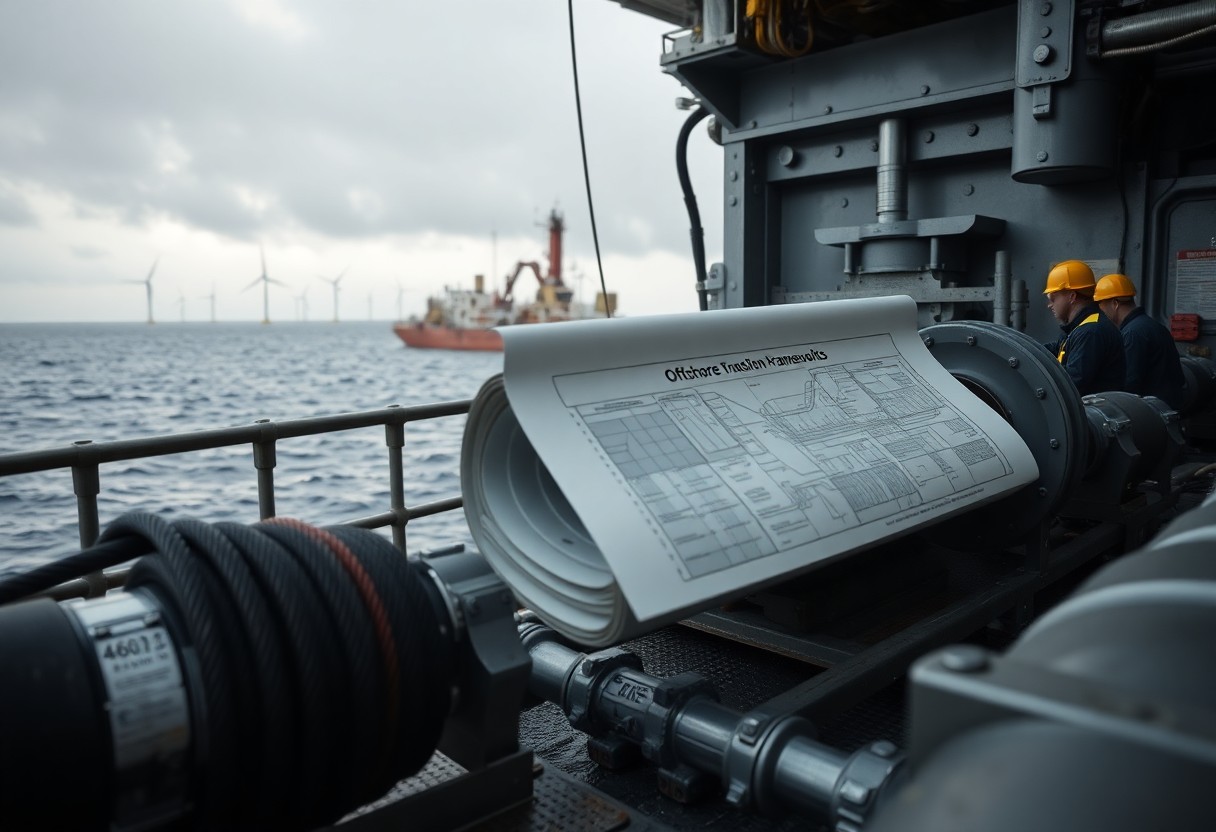
Offshore transition frameworks face mounting pressure; I assess operational, compliance, and talent risks and outline clear steps you can apply to keep your projects on schedule and within budget.
The Evolving Landscape of Offshore Energy
Historical reliance on hydrocarbon extraction and the pivot to net-zero
Offshore oilfields sustained national revenues and skilled workforces for decades; I have watched how that reliance built ports, vessel fleets and regulatory frameworks you still use. I assess how the pivot to net-zero forces repurposing of assets and retooling of labour while legacy contracts and fiscal regimes constrain your transition choices.
The dual challenge of global energy security and carbon neutrality
Geopolitics and supply security now sit alongside emissions targets, and I argue you cannot treat them as separate policy tracks. I note that policy trade-offs will shape where investment flows and how quickly you can retire fossil assets without creating energy gaps.
Operators face compressed timelines as governments demand immediate capacity while also tightening carbon budgets, and I expect financing, insurance and permitting practices you rely on to adjust in response. I also see strategic stockpiles and flexible gas plants persisting as transition insurance, which complicates planning horizons.
Current global capacity and projected growth of offshore renewable assets
Today offshore wind arrays and emerging floating platforms are scaling beyond pilot stages, and I track how manufacturing capacity and specialized vessels must expand for you to meet deployment targets. I recommend assessing port readiness and workforce retraining as near-term priorities.
Forecasts show several-fold growth in installed offshore renewables this decade, and I stress that material supply chains, grid upgrades and consenting frameworks will determine whether you meet stated ambitions or face slippage that affects your energy security. I follow how policy certainty can accelerate or stall that trajectory.
Offshore transition frameworks under pressure
Limitations of legacy maritime laws in modern energy transition contexts
Maritime laws were written to govern navigation, shipping liability and territorial claims, not dense offshore energy corridors or integrated grid assets. I see how you face overlapping jurisdictions, unclear seabed rights and outdated environmental tests that slow approvals and raise costs for your projects.
Harmonization of cross-border grid regulations and permit streamlining
Cross-border grid rules vary on technical standards, interconnection studies and permit timelines, creating coordination challenges for developers and operators. I argue that aligning technical codes and synchronizing permit windows would help you reduce delays and better plan cross-jurisdiction builds.
Regulators can adopt mutual recognition of impact assessments, establish joint permitting authorities and create shared data platforms to speed decisions. I propose that a common digital permit portal and standardized environmental scopes would give you clearer expectations and shorter lead times.
Impact of the Inflation Reduction Act and EU Green Deal on offshore policy
Inflation Reduction Act incentives and the EU Green Deal funding are shifting investment flows, tilting policy toward rapid deployment and domestic content rules. I watch how you can capture incentives only if permitting regimes and local supply policies are reconciled with project timelines.
European measures emphasize coordinated maritime planning and state aid clarity while the IRA ties benefits to domestic manufacturing and wage conditions, affecting supplier choices. I expect your project economics to depend on harmonizing content requirements and permit schedules across markets.
Offshore transition frameworks under pressure
Levelized Cost of Energy (LCOE) trends for offshore wind and solar
Costs for offshore wind have declined as turbine scale and installation efficiency improved, and I assess that offshore solar still trails on balance-of-system expenses, which will influence where you target capital.
Turbine size gains and standardized foundations push wind LCOE lower, and I compare levelized costs regularly to advise you on project selection and risk allocation.
Carbon pricing mechanisms and their influence on offshore operations
Grid operators and developers face stronger carbon signals from emissions trading schemes, and I see these prices shifting operational dispatch and maintenance planning for offshore assets you own.
Pricing volatility in carbon markets alters expected revenue streams, so I factor allowance costs into project models to show you how compliance or credit strategies affect returns.
Impacts on asset valuation can be material when carbon prices rise, and I recommend you stress-test portfolios against scenario ranges to protect your balance sheet and contractual positions.
Market volatility and the impact on long-term Power Purchase Agreements (PPAs)
Market instability in wholesale power changes the attractiveness of long-term PPAs, and I advise structuring price floors and indexed clauses so your projects remain bankable.
Volatility increases counterparty risk and can force renegotiations, so I assess counterpart credit and include flexibility that lets you hedge exposure without losing revenue certainty.
Contracting complexity rises as parties demand revenue-sharing and indexation to new fuels and transmission costs, and I draft terms that balance your operational realities with investor return expectations.
Technological Innovation and Infrastructure Integration
Advancements in subsea power transmission and high-voltage DC links
Subsea power transmission is advancing with modular high-voltage DC links that I monitor for reduced losses and scalable capacity, and you will see lower curtailment and clearer integration paths to onshore grids.
Hybridization of offshore assets: Combining wind, wave, and solar energy
Hybridization of wind, wave and floating solar assets lets me quantify complementary generation profiles, and you can plan for higher annual yield and shared operations to lower levelized costs.
Combining intelligent control systems and battery buffering, I find, smooths output variability and helps you meet firming requirements, though it increases system complexity and interconnection planning.
The role of Carbon Capture and Storage (CCS) in offshore depleted reservoirs
Offshore carbon capture and storage in depleted reservoirs presents me with opportunities to repurpose platforms and you can reduce emissions footprints by injecting CO2 where geological storage capacity and monitoring plans are sound.
Monitoring suites I recommend pair permanent seismic surveys, downhole pressure gauges and satellite observables to verify containment, giving you actionable data for regulatory compliance and long-term stewardship.
Offshore transition frameworks under pressure
Bottlenecks in specialized vessel availability and shipyard capacity
Shipyards are booked years in advance, and I watch project windows compress as jack-up vessels and heavy lifts become scarce; you should expect longer waits and higher charter rates that push your project economics.
Demand for retrofits and specialist crews tightens schedules further, so I recommend you secure long-lead contracts, consider phased deployments, and explore shared logistics to protect your timelines.
Raw material scarcity and the geopolitical control of rare earth minerals
China controls a large portion of processing capacity, and I advise you to treat export policy shifts as an operational risk that can disrupt your component supply chains within months.
Supply concentration drives price spikes and allocation risk, so I urge you to map critical materials, diversify suppliers, and build contingency stocks or recycling loops to reduce exposure.
Policy responses I expect include strategic stockpiles, investment in downstream processing outside dominant jurisdictions, and bilateral trade agreements; I suggest you engage procurement and government affairs early to shape access and timelines.
Port infrastructure upgrades required for large-scale turbine assembly
Quays need reinforcement and deeper drafts to handle turbine components, and I tell you that your site selection must factor berth depth, crane capacity, and laydown area to avoid costly last-minute moves.
Port staging and intermodal links create bottlenecks if not planned, so I recommend you coordinate berthing windows with port authorities, secure road and rail clearances, and schedule seasonal work to match tidal constraints.
Upgrades often require phased capital and permits that take years; I advise structuring public-private funding, modular assembly sheds, and grid reinforcement plans early to align construction timelines with vessel availability.
Geopolitical Implications and Resource Sovereignty
Maritime boundary disputes and energy resource ownership in exclusive economic zones
Disputes over EEZ boundaries reshape who claims hydrocarbons and subsea minerals; I find that ambiguous limits raise legal costs and security risks, and you must factor boundary uncertainty into exploration budgets, contractual clauses, and contingency planning.
The strategic importance of the seabed in international relations
Seabed resources have become a strategic asset as deepwater technology unlocks reserves and minerals; I see increased military interest in protecting undersea infrastructure, and you should weigh geostrategic risk alongside commercial viability when assessing projects.
States are expanding continental shelf claims and submitting geological data to the Commission on the Limits of the Continental Shelf, which I track closely; you will face longer permitting timelines, contested claims, and the need for diplomatic risk mitigation in your project timelines.
Energy independence strategies through offshore domestic production
Offshore domestic production offers a path to reduce import exposure, prompting policy shifts toward faster permitting and targeted subsidies that I monitor; you ought to model domestic supply scenarios against export ambitions and price volatility to inform investment decisions.
Fiscal terms and local content requirements shape investor appetite and social license, so I recommend stress-testing project economics and stakeholder engagement plans to secure political backing and protect your long-term supply expectations.
Offshore transition frameworks under pressure
Biodiversity conservation and the protection of benthic ecosystems
Marine benthic habitats face added disturbance from turbine foundations and cable routes, and I press for precise baseline surveys so you can see likely impacts before permitting.
I recommend adaptive trenching and seasonal restrictions, and you should require siting buffers and restoration commitments to reduce long-term damage to cold-water corals and sponge fields.
Managing noise pollution and its effects on marine mammal migration
Sound from pile-driving and vessel traffic disrupts migratory routes, and I urge use of quieter installation methods so you and your teams can limit displacement.
Mitigation measures like soft-starts, bubble curtains and seasonal windows reduce acute harm, while I push for long-term monitoring tied to adaptive limits so you can evaluate outcomes.
Monitoring provides the data I rely on to set trigger points, and you should demand public access to acoustic datasets to align shipping lanes and wind operations with migration timing.
Conflict resolution between energy developers and the commercial fishing industry
Fishers experience gear loss and exclusion zones, and I champion co-management tables where you can negotiate compensation, transit corridors and rotational use.
Collaborative mapping of critical grounds allows regulators to set enforceable protections, and I recommend your indemnity schemes address economic losses.
A binding dispute-resolution clause and independent arbitration have proved effective in trials I observed, giving you rapid redress and predictable timelines.
Offshore transition frameworks under pressure
The rising cost of capital and its effect on Final Investment Decisions (FIDs)
Higher borrowing costs are forcing me to re-evaluate project IRRs and delay FIDs while I run sensitivity analyses, and I encourage you to stress-test cash flows against rising debt service and tighter covenant terms.
Insurance and risk mitigation for extreme weather events and sea-level rise
Insurance premiums linked to storm frequency push me to model tail risks conservatively, and I advise you to budget for escalating deductibles and policy exclusions that can change project viability.
Reinsurers are reducing capacity in exposed regions, so I suggest you consider parametric solutions, multi-year placements, and public-private risk pools to protect your balance sheet and maintain bankability.
Green bonds and ESG reporting requirements for offshore developers
Green bond covenants require me to define eligible expenditures and measurable outcomes up front, and I ask you to embed monitoring systems early to secure preferential pricing and investor confidence.
Reporting demands from lenders and rating agencies lead me to prioritize third-party verification and transparent use-of-proceeds tracking so your investors can assess performance and compliance over the asset lifecycle.
Workforce Transition and Human Capital
Skillset transferability from oil and gas to renewable energy sectors
Experience in oil and gas gives me a clear view of transferable competencies: subsea engineering, asset integrity, corrosion control, offshore logistics and HSE culture. I can show how those skills map to wind, tidal and green hydrogen projects so your team shortens ramp-up time with targeted retraining.
Practical courses in electrical systems, power electronics and turbine mechanics bridge gaps I observe on site; you gain faster returns when certifications align with NDT and electrical safety standards. I advocate hands-on apprenticeships and simulator time to convert procedural familiarity into sector-specific competence.
Addressing the global talent shortage in offshore engineering and technicians
Shortages in qualified offshore engineers and technicians force me to focus on scalable training pipelines and remote supervision models. I recommend modular certification and incentives that help you retain staff in remote postings while meeting project timelines.
Training that blends online theory with on-site shadowing reduces deployment delays I often encounter; you build operational confidence quicker when competency assessments are frequent and tied to career progression.
Partnerships with universities and vocational schools create apprenticeship routes I embed into project plans so your hiring lead times shrink and succession becomes clearer.
Health and safety standards in increasingly remote and harsh environments
Standards for remote offshore operations are evolving and I track regulatory updates closely to keep teams compliant. You should expect stricter rules for remote monitoring, emergency response drills and contractor vetting as sites move farther offshore.
Risk management must adjust to extended response times and harsher weather; I implement layered controls, redundant communications and fatigue management to protect crews and assets in isolated conditions.
Emergency preparedness needs realistic drills, interoperable evacuation plans and medevac arrangements I review with operators so your response functions under stress and simulation frequency reduces human error in extreme incidents.
Digitalization and Cyber-Physical Security
Digitalization is compressing decision cycles on and offshore; I track how your edge devices, control systems, and cloud analytics interact so I can harden telemetry flows, enforce minimum privileges, and maintain incident playbooks that keep operations functional under strain.
Digital twins and predictive maintenance for offshore asset longevity
I model your turbines and subsea equipment with digital twins to predict failures before they occur, scheduling targeted maintenance windows and validating sensor fidelity so you avoid expensive emergency mobilizations and extend useful asset life.
Vulnerabilities of undersea cables and remote communication infrastructure
Undersea cables present concentrated risk for your SCADA and telemetry; I evaluate route redundancy, landing station security, and detection capabilities because physical damage, tapping, or jurisdictional delays can produce prolonged outages with high operational and political cost.
Cable monitoring using distributed acoustic sensing, latency profiling, and out-of-band integrity checks gives me and you earlier warning; I recommend encryption, satellite fallback, and pre-contracted repair capacity to shorten downtime and limit exposure.
AI-driven optimization of energy yields and grid stability
Algorithms now optimize wake steering, pitch control, and market participation to increase yields and stabilize grid inputs; I integrate your operational telemetry and market signals so models propose safe setpoints while preserving audit trails for your compliance needs.
Model governance forces me to run drift detection, adversarial testing, and encrypted training pipelines so you can trust automated decisions; I require human-in-the-loop thresholds and kill-switches to prevent unsafe autonomous actions.
Regional Comparative Analysis
| Region | Key focus |
|---|---|
| North Sea | Cross-border grids, joint decommissioning, pooled finance |
| Gulf of Mexico | Platform repurposing, CO2 storage, regulatory adaptation |
| Asia-Pacific | Rapid scale, port capacity, workforce and permitting |
The North Sea model: A blueprint for cross-nation collaboration
I see the North Sea delivering clear governance templates: joint transmission operators and standardized contracts cut costs and speed deployment, and I advise you to study those agreements when structuring regional hubs.
Policy-makers there created predictable permitting windows that I find effective; your projects should replicate staged approvals and pooled grid planning to reduce duplication and investor risk.
The Gulf of Mexico: Adapting existing infrastructure for a low-carbon future
Gulf operators are repurposing platforms and pipelines for CO2 storage and hydrogen feedstock, and I encourage you to start integrity assessments early to avoid costly surprises during conversion.
Retrofitting timelines compress when I align inspection regimes with conversion plans, and your teams must budget for phased upgrades to keep assets productive while adapting them.
Existing joint-venture financing in the Gulf offers templates I recommend copying, and you should press for clear liability frameworks so private partners accept long-term transition risk.
Asia-Pacific: Rapid scaling challenges in emerging offshore markets
Asia-Pacific markets scale fast but often lack coordinated grid build-out, and I stress to you the need for port upgrades and trained crews to match deployment speed without raising costs.
Scaling without standard contracts creates delays; I advise you to push for template agreements and local supply-chain investments to shorten project timelines and reduce political exposure.
Regional hubs tied to utility demand provide useful entry points I use when advising clients, and your focus on modular platforms will help compress build cycles and mitigate financing risk.
Legal Hurdles and Decommissioning Liabilities
The “Rigs-to-Reefs” debate and environmental liability transfer
I have seen rigs-to-reefs proposals shift decommissioning burdens toward public bodies and NGOs, and that transfer can leave your fiscal exposure opaque when monitoring and remediation obligations persist for decades.
Stakeholders dispute who carries long-term harm claims under these schemes, so I advise clarifying statutory indemnities and insurance backstops before any asset reclassification proceeds.
Regulatory gaps in the decommissioning of first-generation offshore wind farms
Regulatory frameworks for early offshore wind often lack explicit removal standards, and I find operators and regulators misaligned on cable recovery, foundations and financial assurance requirements, exposing your balance sheets to surprise liabilities.
Operators confront permit expiries that outlast corporate lifetimes, which I flag as a generator of orphaned assets unless bonding and enforcement windows are strengthened.
A focused update to permit conditions that mandates decommissioning bonds, defined surveillance periods and clear abandonment triggers would let me assess orphaning risk more accurately and give you firmer cost forecasts.
Contractual complexities in multi-stakeholder offshore energy hubs
Contractual matrices across wind, oil and hydrogen ventures create overlapping obligations, and I observe cascade liability clauses and cross-default terms that can trap parties in joint exposures well after operations cease.
Joint venture and offtake agreements rarely prescribe exit mechanics for decommissioning, so I see disputes over cost allocation and scope that escalate to arbitration and inflate your overall project risk.
Shared governance models should embed predefined liability tranches and modular decommissioning plans, which I recommend to reduce negotiation friction and deliver you clearer legal certainty.
Emerging Trends: Floating Wind and Green Hydrogen
I have observed how floating foundations and hydrogen production are compressing timelines and reshaping risk allocation, forcing you to reassess contracting and permitting strategies as projects move farther offshore.
Technical breakthroughs in deep-water floating platform stabilization
Recent mooring innovations and active ballast control allow me to model platforms that hold station in sea states once deemed prohibitive, giving you clearer access to deep-water sites and lowering lifecycle uncertainty.
Offshore electrolysis: Producing green hydrogen at the source of generation
Developers are trialing electrolyzers on service barges and semi-submersibles; I advise you to consider PEM stacks tuned for variable input so your production matches intermittent supply and avoids export congestion.
Scaling must address desalination needs, materials corrosion, and offshore safety protocols, and I recommend you budget for buffer storage and compression to preserve hydrogen value before onshore delivery.
Power-to‑X concepts and the future of offshore energy storage
Offshore Power-to‑X pilots show I can convert surplus generation into ammonia or methanol, giving your projects extended revenue streams beyond volatile electricity markets.
Integration with subsea cables, floating storage, and onshore logistics determines commercial viability, so I prioritize hybrid system studies and contractual models that protect your returns.
Final Words
Summing up I assess that offshore transition frameworks under pressure demand tighter governance, rapid risk triage, and clearer accountability; I recommend you prioritize transferable knowledge, phased handovers, and stress-tested contingency plans so your teams can maintain service levels under strain. I will monitor outcomes and adjust timelines as issues surface to protect value and keep stakeholders informed.
FAQ
Q: What does “offshore transition frameworks under pressure” mean and what drives that pressure?
A: Offshore transition frameworks under pressure refers to strain on the processes and agreements used to move operations, services, or staff offshore when external forces force change. Drivers include tighter data and tax regulation, geopolitical friction, rising labor and compliance costs, buyer demands for more control and transparency, and shifts toward nearshore or onshore alternatives.
Q: How should organizations respond operationally to stresses on offshore transition frameworks?
A: Organizations should reassess governance, contract terms, service-level agreements, and exit clauses to reduce exposure and increase flexibility. Short-term actions include stress-testing business continuity plans, auditing data flows for compliance, and negotiating flexible pricing tied to performance. Longer-term options involve piloting nearshore or onshore hubs, investing in targeted automation to lower manual labour dependence, and retraining staff for higher-value roles.
Q: What are the main legal and financial implications when transition frameworks come under pressure?
A: Legal teams must map contractual obligations, local labour laws, export controls, and data residency rules to quantify risk and potential penalties. Finance teams should model scenario impacts on cash flow, impairment of transition assets, stranded costs, and tax or transfer-pricing changes from shifting jurisdictions. Board reporting should include trigger thresholds for migration, cost-to-move estimates, and contingency budgets for rapid response.