Risk rarely arrives with a polite warning.
A supplier suddenly fails. A cyber incident interrupts normal operations. New regulation creates an unexpected compliance headache. An AI tool starts producing unreliable outputs. A key employee leaves with knowledge that nobody thought to document. Perhaps a project that looked profitable six months ago begins swallowing time, money, and patience.
None of these situations feels unusual anymore.
That is precisely why risk management frameworks have become so valuable. Risk management frameworks give organisations a structured way to identify uncertainty, assess what genuinely matters, decide how to respond, and keep watching as circumstances change.
Implementing effective risk management frameworks ensures that businesses can navigate challenges with confidence and clarity.
The structure matters because risk management can otherwise become strangely vague. People know risk exists, of course. They discuss it in meetings. They add concerns to spreadsheets. Someone creates a colourful matrix. Another person promises to review it next quarter.
Then normal work takes over.
A proper risk management framework changes that pattern by connecting risk with decisions, ownership, governance, controls, reporting, and business priorities. It creates a repeatable method rather than relying on memory, instinct, or whoever happens to be most worried in the room.
Through risk management frameworks, teams can consistently evaluate risks, ensuring that decisions align with organisational goals while maintaining accountability.
For UK organisations, that discipline can support far more than cybersecurity. A suitable framework may help with operational resilience, financial exposure, regulatory obligations, supply chain uncertainty, data protection, technology governance, strategic planning, and the growing challenge of AI-related risk.
The tricky part is choosing wisely.
Effective risk management frameworks guide organisations in addressing both anticipated and unforeseen risks.
There is no universal framework that magically fits every organisation. A growing technology company has different concerns from a financial services firm. A public sector body operates under different pressures from a family-owned manufacturer. A multinational enterprise may need several complementary approaches because a single framework cannot cover all practical requirements.
The choice of risk management frameworks must reflect the unique needs of the organisation to ensure comprehensive coverage of all relevant risks.
So, which options deserve serious attention?
These seven stand out.
What Is a Risk Management Framework
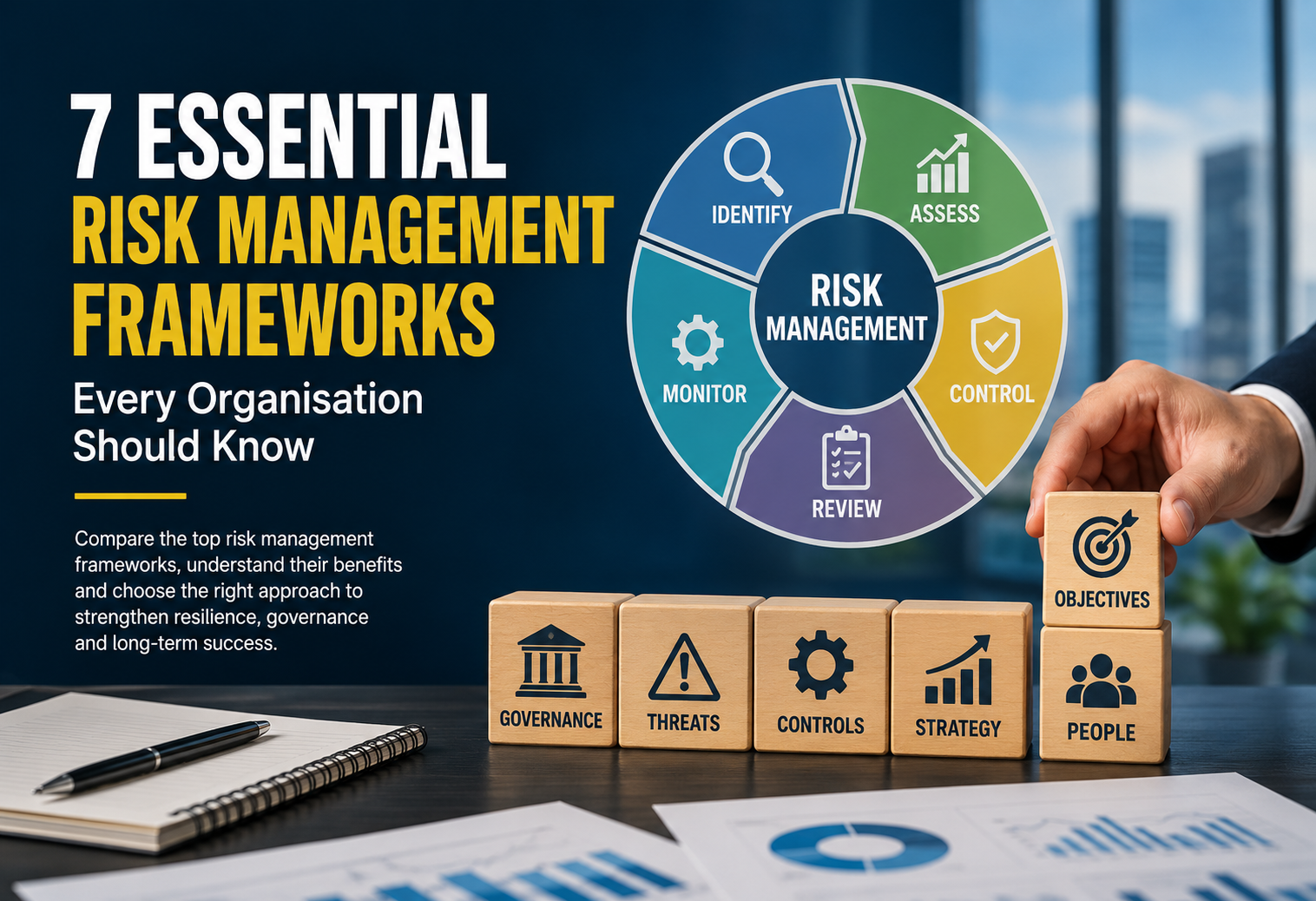
A risk management framework is a structured collection of principles, processes, responsibilities, and practices for identifying, assessing, treating, monitoring, and communicating risk.
That sounds tidy. Real organisations are not.
A framework, therefore, should not be mistaken for a static document that sits quietly on a shared drive. Its real value appears when people use it to make decisions.
Imagine a business preparing to launch a new customer platform. The project may involve personal data, external software providers, payment processes, cloud infrastructure, employees, contractors, legal obligations, and customer expectations. Each part introduces uncertainty.
Without structure, different teams may view the same project through completely different lenses. IT worries about system security. Finance watches costs. Legal considers contractual exposure. Marketing wants a quick launch. Senior management focuses on growth.
Everyone may be correct. That is the awkward bit.
A risk management framework establishes a common process for identifying, comparing, assigning, treating, and monitoring those concerns. It does not remove disagreement, nor should it. Instead, it makes the reasoning visible.
Michael Schmitt approaches risk management as a practical business discipline rather than a box-ticking exercise. That distinction matters because a framework should help an organisation understand uncertainty and act with greater confidence. It should not create paperwork merely for the sake of paperwork.
The Difference Between Risk Management and a Risk Management Framework
Understanding the difference between general risk management and specific risk management frameworks can significantly enhance an organisation’s approach to mitigating risks.
Risk management is the broader practice of managing uncertainty that could affect objectives.
A risk management framework provides the structure for doing that work consistently.
Think of it this way. A manager can respond to a problem when it appears. That is a risk-related activity. Yet if the organisation has no shared criteria, no defined ownership, no monitoring process, and no agreed response method, each problem may be handled differently.
A framework introduces consistency.
Utilising robust risk management frameworks can facilitate effective communication and collaboration across departments regarding risk-related decisions.
It can define who identifies risks, how risks are assessed, which scoring method is used, when senior leaders become involved, what evidence should be retained, how controls are tested, and how changes are reported.
Simple idea. Big difference.
The Core Components of an Effective Risk Management Framework
Different risk management frameworks use different terminology, yet several core elements appear repeatedly. Understanding them first makes it much easier to compare individual frameworks.
Recognising common components of various risk management frameworks enables organisations to tailor their approach based on specific operational contexts.
Risk Identification
You cannot manage a risk nobody has recognised.
Risk identification involves finding events, conditions, dependencies, weaknesses, and uncertainties that could affect objectives. These may come from inside or outside the organisation.
Internal risks might include weak access controls, staff shortages, poor documentation, ageing systems, unclear responsibilities, or overreliance on a single employee.
External risks could include regulatory changes, supplier failures, cyber threats, economic disruptions, geopolitical events, or sudden changes in customer behaviour.
Good identification work goes beyond asking, What could go wrong?
A better question is, what assumptions are we making, and what happens if those assumptions fail?
That question often reveals more.
Risk Assessment
Once risks have been identified, organisations need to understand their significance.
A common approach considers likelihood and impact. Some organisations use simple descriptive ratings. Others use numerical scores, financial models, scenario analysis, or more advanced quantitative methods.
The method should match the decision.
A small business does not necessarily need an elaborate mathematical model for every operational concern. Equally, a large organisation should not reduce a major cyber exposure worth millions of pounds to a vague red label without deeper analysis.
Context matters.
Assessment may consider financial loss, service disruption, legal consequences, safety concerns, reputational damage, customer harm, and strategic impact. Increasingly, organisations also examine how risks interact because a minor problem in one area can trigger a much larger issue elsewhere.
That chain reaction is easy to underestimate.
Risk Treatment and Mitigation
Assessment should lead somewhere.
Once an organisation understands a risk, it can decide how to respond. Common approaches include avoiding the activity, reducing exposure, transferring part of the risk, sharing it, or consciously accepting it.
Acceptance is worth emphasising. Not every risk needs to disappear.
Risk management frameworks emphasize the importance of informed decision-making rather than simply mitigating every potential risk.
Business itself involves uncertainty. An organisation that tries to eliminate every conceivable risk may also eliminate speed, innovation, and commercial opportunity. Effective risk management is therefore not about making the organisation timid.
It is about taking informed risks.
Risk Monitoring and Reporting
Regular monitoring and updates to risk management frameworks can significantly enhance organisational resilience to emerging threats.
A risk register that has not been updated for 2 years is not reassuring—quite the opposite.
Risks evolve. Controls weaken. Employees change roles. Suppliers alter their services. Technology moves on. New vulnerabilities appear. Business priorities shift.
Monitoring keeps the framework connected to reality.
Reporting then provides decision-makers with useful visibility. The Word “useful” is doing plenty of work here, because more reporting does not automatically mean better oversight. A board rarely benefits from receiving hundreds of undifferentiated risks.
It needs clarity.
Which exposures are increasing? Which controls are failing? Where are decisions overdue? What has changed since the previous review? Which risks could affect strategic objectives?
That is the information that moves conversations forward.
Risk Governance
Governance answers the uncomfortable questions.
Who owns this risk? Who can accept it? Who tests the control? Who challenges the assessment? Who reports a significant change? Who has the authority to spend money on treatment?
If everybody owns a risk, nobody really owns it.
Strong governance creates accountability without turning every decision into a bureaucratic marathon. Roles should be understood, escalation routes should be clear, and senior leaders should know where their responsibilities begin.
Now to the frameworks themselves.
Choosing and implementing effective risk management frameworks will ultimately lead to stronger business performance and risk mitigation.
1. ISO 31000 Risk Management Framework
ISO 31000 is one of the best-known approaches to enterprise risk management. It offers principles and guidance that organisations can use to integrate risk thinking into governance, strategy, planning, operations, and decision-making.
Its broad applicability is a major attraction.
Unlike a framework designed specifically for cybersecurity or IT governance, ISO 31000 can support organisations across industries and risk categories. A manufacturing company might apply its principles when considering supply chain disruptions. A professional services firm could apply them to strategic and operational exposure. A technology business might use the same broad structure while examining rapid growth.
That flexibility is useful, though it also means organisations must think for themselves. ISO 31000 is not a ready-made answer to every risk question.
Nor should it be.
What Makes ISO 31000 Different
The framework places strong emphasis on integration. Risk management should not operate as an isolated activity performed by one specialist team after important decisions have already been made.
It should sit within decision-making itself.
Suppose a UK company plans to enter a new market. Under a genuinely integrated approach, risk thinking begins during strategy development. Leaders consider regulatory exposure, investment requirements, supplier dependencies, local competition, operational capacity, and potential downside before committing.
That is far more useful than approving the strategy first and asking the risk team to review it afterwards.
A bit late by then, surely?
ISO 31000 also recognises human and cultural factors. This deserves more attention than it often receives because organisations do not manage risk through diagrams alone. People interpret information, protect budgets, challenge assumptions, remain silent, escalate concerns, or sometimes avoid awkward conversations.
Culture changes outcomes.
Who Should Consider ISO 31000
ISO 31000 can suit organisations seeking a broad, adaptable risk management framework rather than a narrowly technical model.
It may be particularly useful when an organisation wants to create a shared language around risk, connect risk with strategic objectives, improve governance, or establish consistent processes across departments.
For many businesses, it provides a strong foundation.
2. NIST Cybersecurity Framework 2.0
Cyber risk is now business risk.
That statement gets repeated often, perhaps too often, yet the underlying point remains sound. A serious cyber incident can affect revenue, customer confidence, operations, legal exposure, suppliers, and strategic plans. Treating cybersecurity as something that belongs exclusively to the IT department no longer makes much sense.
The NIST Cybersecurity Framework offers a structured approach to managing cybersecurity risk.
The NIST Cybersecurity Framework serves as one example of how structured risk management frameworks can enhance cyber resilience.
Its flexibility has helped make it widely recognised. Organisations can use the framework regardless of sector, size, or technical maturity, adapting it according to their own circumstances.
The Six Core Functions of NIST CSF 2.0
NIST CSF 2.0 organises cybersecurity outcomes around six core functions.
- Govern
- Identify
- Protect
- Detect
- Respond
- Recover
The addition and prominence of governance is particularly significant because cybersecurity decisions depend on leadership, accountability, policy, risk appetite, and oversight.
Consider a simple example. An organisation may invest heavily in security technology, yet still have unclear responsibility for third-party risk. Who approves a critical supplier? Who reviews its security position? Who responds if warning signs appear?
Technology cannot resolve unclear ownership.
The Identify function helps organisations understand assets, dependencies, risks, and the environment in which they operate. Protect focuses on safeguards. Detect concerns the ability to recognise potential incidents. Respond covers action when something happens. Recover supports restoration and resilience.
The functions connect. That is the point.
Why UK Organisations May Find NIST Useful
UK organisations often operate across overlapping regulatory, commercial, and security expectations. NIST CSF 2.0 can provide a practical structure for discussing cyber risk with both technical and non-technical stakeholders.
A board member does not need to understand every security configuration to ask whether critical services can be recovered after disruption. A technology leader should be able to explain how key risks connect with business priorities.
The framework can help create that bridge.
3. COSO Enterprise Risk Management
COSO Enterprise Risk Management takes a broad view of risk and places particular emphasis on the relationship between risk, strategy, and performance.
COSO ERM illustrates the connection between risk management frameworks and broader organisational strategy.
That relationship is crucial.
Organisations sometimes treat risk as a defensive subject, something associated with preventing bad events. Yet uncertainty also affects the organisation’s ability to choose strategies, pursue opportunities, allocate capital, and achieve performance targets.
COSO ERM pushes the conversation into that territory.
The Five Core Components of COSO ERM
The framework is organised around five interconnected components.
- Governance and culture.
- Strategy and objective setting.
- Performance.
- Review and revision.
- Information, communication, and reporting.
These components encourage organisations to examine risk throughout the process of setting direction and measuring results.
Take performance targets. A business may set an aggressive growth objective and then reward managers heavily for achieving it. Fine. But what behaviours could those incentives create? Could teams accept weak customers, rush quality checks, underprice contracts, or overlook compliance concerns?
Targets create risk too.
COSO ERM encourages leaders to examine those connections rather than treating strategy, performance, and risk as separate conversations.
Where COSO ERM Can Be Particularly Valuable
COSO ERM may appeal to larger organisations, businesses with mature governance structures, and leadership teams seeking to connect enterprise risk to strategy and performance.
It can also help when risk information is fragmented across departments.
Finance sees one picture. Operations sees another. Technology has its own concerns. Compliance maintains separate records. Senior leaders then receive several reports that do not quite speak the same language.
Sound familiar?
An enterprise approach can improve visibility across those boundaries.
4. COBIT 2019
COBIT 2019 focuses on the governance and management of enterprise information and technology.
COBIT complements risk management frameworks by ensuring alignment between IT governance and business objectives.
That makes it especially relevant in organisations where technology is deeply connected with business objectives. Which, frankly, now describes a very large number of organisations.
Developed by ISACA, COBIT helps organisations consider how information and technology should be governed, managed, measured, and aligned with stakeholder needs.
Why COBIT Is More Than an IT Checklist
A common mistake is to see technology governance as a purely technical concern.
It is not.
Imagine an organisation relying on several critical cloud platforms. The technical teams may understand system configurations, but senior management also needs answers to broader questions. Are responsibilities clear? Do technology investments support business goals? Are critical dependencies understood? Is performance measured? Are risks accepted at the correct level?
COBIT helps frame these governance questions.
It distinguishes governance from management. Governance concerns evaluating stakeholder needs, setting direction, and monitoring outcomes. Management focuses on planning, building, running, and monitoring activities in line with that direction.
The distinction sounds subtle until something goes wrong.
Then it becomes very obvious.
Who May Benefit From COBIT 2019
COBIT can be useful for organisations seeking stronger IT governance, clearer alignment between technology and business priorities, or more structured oversight of information and technology-related risk.
It may also complement other standards and frameworks. Organisations do not always need to choose one model and reject everything else. In practice, a thoughtful combination often works better, provided responsibilities remain clear and duplication is controlled.
Framework collecting is not risk management.
5. FAIR Risk Management Framework
FAIR stands for Factor Analysis of Information Risk.
FAIR can enhance organisations’ understanding of financial implications within their risk management frameworks.
Its distinctive feature is quantitative risk analysis. Rather than relying mainly on labels such as low, medium, and high, FAIR helps organisations analyse information and cyber risk in financial terms.
This can change the quality of a conversation.
Suppose two cyber risks are both labelled high. Which one deserves investment first? How much investment is reasonable? What potential loss exposure does each risk represent? How frequently might loss events occur?
A red box cannot answer those questions.
FAIR attempts to bring greater analytical discipline to risk estimation by examining factors related to loss-event frequency and loss magnitude.
Why Quantification Can Matter
Senior leaders regularly make decisions involving money. They compare investments, margins, expected returns, costs, and financial scenarios.
Cyber risk discussions, however, have often relied on subjective scoring systems.
That creates a communication gap.
A security professional may describe a vulnerability as critical. A finance director may ask what that means for the business. If the answer is simply, It is critical because the matrix says so, the discussion stalls.
FAIR can help teams express uncertainty in a language that supports financial decision-making.
This does not mean quantitative models produce perfect predictions. They do not. Risk analysis still depends on assumptions, data quality, ranges, judgement, and uncertainty.
Numbers can look precise even when they’re wrong.
Used carefully, though, quantification can improve prioritisation and make assumptions easier to challenge.
Who Should Consider FAIR
FAIR may suit organisations with mature cyber or information risk practices, especially where leaders want to compare risk exposure with investment decisions.
It can be particularly valuable when qualitative scoring no longer provides enough detail.
6. OCTAVE
OCTAVE’s asset-focused approach aligns with the overarching goals of risk management frameworks.
OCTAVE stands for Operationally Critical Threat, Asset, and Vulnerability Evaluation.
The name is a mouthful. The central idea is easier.
Understand what matters to the organisation. Identify threats to those critical assets. Examine vulnerabilities. Then develop protection strategies based on the business context.
OCTAVE takes an organisation-centred approach to information security risk. Rather than starting with technology alone, it encourages teams to consider critical assets and operational needs.
How OCTAVE Approaches Risk
An organisation first needs to understand which information assets are genuinely important.
That question can be surprisingly difficult.
Teams often accumulate systems, databases, documents, applications, and services over many years. Some are obviously critical. Others become important through hidden dependencies that nobody notices until disruption occurs.
OCTAVE encourages structured examination of assets, threats, and vulnerabilities.
For example, a business might identify a customer database as critical. It then considers threats that could affect confidentiality, integrity, or availability. Next comes the uncomfortable inspection of weaknesses, existing practices, and potential exposure.
The resulting strategy should reflect organisational priorities.
When OCTAVE May Be a Good Fit
OCTAVE can be useful for organisations seeking a structured, asset-focused approach to information security risk assessment.
It may appeal to teams that need to connect technical vulnerabilities with operational consequences. That connection matters because not every technical weakness creates the same business impact.
Context decides.
7. ISO IEC 42001 for AI Management
ISO IEC 42001 is crucial for integrating AI governance into existing risk management frameworks.
Artificial intelligence has moved from an experimental side project to an operational reality at a remarkable speed.
Employees use generative AI tools. Businesses add AI features to products. Teams automate decisions. Customer service functions deploy AI assistants. Organisations process data through systems they may not fully understand.
Useful? Absolutely.
Risk-free? Not remotely.
ISO IEC 42001 provides requirements for establishing, implementing, maintaining, and continually improving an AI management system.
This makes it particularly relevant as organisations seek a structured approach to responsible AI governance.
Why AI Needs Specific Governance
Traditional risk management remains valuable, but AI introduces distinctive questions.
What data was used? How is output quality monitored? Could the system produce biased outcomes? Who is accountable for decisions? Can employees recognise unreliable results? Are privacy obligations understood? What happens when an AI model changes?
Then there is the simplest question of all.
Should AI be used for this task in the first place?
That question often gets skipped because the technology is available and enthusiasm moves faster than governance.
ISO IEC 42001 encourages a management system approach. Organisations can establish policies, objectives, responsibilities, risk management processes, monitoring practices, and continuous improvement mechanisms for AI.
Who Should Consider ISO IEC 42001
The standard is relevant to organisations that develop, provide, or use AI systems.
That scope is broad by design.
A company does not need to build its own foundation model to address AI-related risks. A business using third-party AI tools may still need to consider data handling, accountability, reliability, supplier dependencies, employee use, and customer impact.
For organisations moving beyond casual experimentation, structured AI governance is becoming increasingly sensible.
How to Choose the Right Risk Management Framework
Organisations must strategically assess their objectives before selecting their risk management frameworks.
Here is where people often want a neat answer.
There is not one.
The best framework depends on the organisation’s objectives, industry, risk profile, regulatory environment, maturity, resources, technology, and existing governance arrangements.
Choosing based on popularity alone is a poor method.
Start With the Risks That Matter
Before selecting a framework, clarify the problem.
Is the organisation trying to improve enterprise risk governance? Strengthen cybersecurity? Quantify cyber exposure? Improve IT governance? Manage AI responsibly? Build a common risk language across departments?
Different answers point towards different frameworks.
ISO 31000 may provide broad guidance for the enterprise. NIST CSF 2.0 may suit cybersecurity risk. FAIR may support quantitative cyber risk analysis. COBIT can strengthen information and technology governance. ISO IEC 42001 addresses AI management.
The purpose should drive the choice.
Consider Existing Processes
A framework does not arrive in an empty organisation.
Existing policies, committees, audits, controls, reporting cycles, and responsibilities already shape how work gets done. Ignoring them can create duplication.
Suppose teams already maintain several risk registers. Introducing another framework by creating yet another register may make visibility worse rather than better.
Map what exists first.
Some processes may be useful. Others may be outdated. A few may exist purely because nobody has dared to remove them.
Every organisation has those.
Match Complexity With Capability
A sophisticated framework can fail if the organisation lacks the capacity to operate it.
That does not mean smaller organisations should avoid strong risk management. It means implementation should be proportionate.
A concise, consistently used process is usually better than a beautiful methodology that nobody understands.
Consider staff capability, available data, leadership support, technology, time, and governance maturity. Then build accordingly.
How to Implement a Risk Management Framework
Implementing risk management frameworks requires clear objectives to ensure alignment with organisational goals.
Selecting a framework is only the beginning. Implementation determines whether it becomes a useful management system or another document gathering digital dust.
Define Clear Objectives
Start by stating what the organisation wants to achieve.
Perhaps the goal is better visibility of strategic risk. Maybe the business needs stronger cybersecurity governance. Perhaps leaders want consistent assessment across departments.
Be specific.
Vague objectives create vague implementation.
Establish Leadership Ownership
Senior support cannot be ceremonial.
Leaders need to understand the framework, approve responsibilities, allocate resources, challenge information, and use risk insights when making decisions.
If employees see that risk processes do not influence real decisions, participation quickly becomes mechanical.
People notice.
Identify and Assess Risks
Create a structured process for identifying risk across relevant areas.
Use workshops, interviews, incident data, audit findings, operational information, supplier reviews, scenario analysis, and other appropriate evidence.
Then assess risks using agreed criteria.
Consistency matters, but so does judgement. A scoring model should support thinking rather than replace it.
Define Risk Appetite and Tolerance
How much uncertainty is the organisation prepared to accept while pursuing objectives?
That is the essence of risk appetite.
The answer may differ by category. A company might accept meaningful commercial uncertainty when testing a new service while maintaining very low tolerance for serious legal or safety failures.
Clear appetite statements can improve decisions, especially when they connect with measurable thresholds.
Otherwise, risk appetite becomes a phrase people admire in presentations and ignore in practice.
Assign Risk Owners
Assigning risk owners is essential for effective risk management frameworks to function properly.
Every significant risk needs clear ownership.
The owner should have sufficient authority and understanding to oversee the risk, monitor changes, and support treatment decisions.
Ownership should not automatically fall to the risk team.
Risk specialists facilitate, challenge, advise, and monitor. Business leaders often own the actual exposure because they control the relevant objectives, resources, and decisions.
Select and Implement Controls
Controls should respond to identified risks.
These may include policies, approvals, technical safeguards, training, contractual measures, monitoring, segregation of duties, continuity arrangements, or other actions.
More controls are not always better.
A bloated control environment can create cost and confusion while failing to address the real exposure. Focus on control design, effectiveness, ownership, and evidence.
Monitor Change Continuously
A framework needs regular review.
Watch for new threats, control failures, business changes, incidents, regulatory developments, supplier issues, and shifts in strategic priorities.
Some risks require frequent monitoring. Others can be reviewed less often.
Use judgement.
The phrase “continuous monitoring” should not be used as an excuse to bombard decision-makers with endless notifications.
Improve the Framework Over Time
No first implementation will be perfect.
Review what works. Find bottlenecks. Remove duplicate processes. Improve data. Clarify responsibilities. Adjust reporting.
A mature framework evolves with the organisation.
That is a strength, not a flaw.
Common Mistakes That Weaken Risk Management
Even respected risk management frameworks can fail when implementation becomes disconnected from reality.
Treating the Framework as a Compliance Exercise
Compliance matters, but a framework should help people make better decisions.
If employees complete assessments only because an audit requires them, the process may generate evidence without generating insight.
That is expensive theatre.
Creating Too Many Risks
Some organisations build enormous risk registers containing every conceivable problem.
The result is usually noise.
A useful framework should distinguish between strategic exposure, operational concerns, control issues, incidents, and routine tasks. Not every problem belongs at the same level.
Using Subjective Scores Without Challenge
A five-by-five matrix can be useful. It can also create false confidence.
Why is likelihood rated four rather than three? What evidence supports the impact score? Are teams using the same criteria?
Ask.
The coloured square is the end of the calculation, not the beginning of the thinking.
Ignoring Connected Risks
Risks rarely respect departmental boundaries.
A supplier failure may become an operational issue, then a customer issue, then a financial issue, then a reputational issue.
Frameworks should help organisations see dependencies and cascading effects.
Forgetting Human Behaviour
Policies do not act. People do.
Employees make decisions under pressure. Managers respond to incentives. Teams develop shortcuts. Leaders sometimes discourage uncomfortable information without meaning to.
Any serious approach to risk management must account for behaviour and culture.
The Business Benefits of Strong Risk Management Frameworks
A well-implemented framework does more than reduce the chance of unpleasant surprises.
It can improve the quality of management itself.
Better Decision Making
Leaders gain clearer information about uncertainty, trade-offs, and potential consequences.
This does not make decisions easy. It makes them better informed.
Stronger Organisational Resilience
Organisations that understand critical dependencies and prepare responses can often react more effectively when disruption occurs.
Resilience is not the absence of problems.
It is the ability to absorb disruption, adapt, recover, and keep essential objectives in view.
Greater Stakeholder Confidence
Customers, investors, employees, partners, and regulators often expect organisations to demonstrate responsible management.
A credible framework can support that confidence by showing that risks are identified, owned, monitored, and addressed systematically.
More Confident Innovation
Risk management and innovation are not enemies.
Quite the opposite.
When organisations understand uncertainty, they can experiment with clearer boundaries. They can identify unacceptable exposure early, protect critical assets, and make conscious decisions about where greater risk is justified.
Good risk management creates room to move.
Building a Risk Management Approach That Fits Your Organisation
The strongest risk management frameworks do not succeed because their diagrams look impressive.
The ultimate goal of risk management frameworks is to ensure a proactive and informed approach to risk across the organisation.
They succeed when people use them.
ISO 31000 offers broad principles for integrating risk into organisational decision-making. NIST CSF 2.0 provides a flexible structure for cybersecurity outcomes. COSO ERM connects risk with strategy and performance. COBIT 2019 strengthens the governance of enterprise information and technology. FAIR supports quantitative analysis of information risk. OCTAVE brings an asset-focused perspective to information security. ISO IEC 42001 provides a management system approach for the rapidly developing field of AI.
Each solves a different problem.
The real task is not asking which framework sounds most prestigious. It is asking which approach helps your organisation understand uncertainty, make stronger decisions, clarify accountability, and respond when conditions change.
Michael Schmitt supports a practical view of risk management, one grounded in organisational reality rather than fashionable terminology. A risk management framework should fit the business, its objectives, its people, and the decisions they actually face.
Start with what matters. Understand the exposure. Choose a proportionate framework. Assign genuine ownership. Monitor change. Improve the process when reality proves your assumptions wrong.
Because it will.
Frequently Asked Questions About Risk Management Frameworks
What is the purpose of a risk management framework?
A risk management framework provides a structured way for an organisation to identify, assess, manage, and monitor risks. Its main purpose is to support informed decisions, protect important assets, reduce unnecessary exposure, and help the organisation pursue strategic objectives with greater confidence.
A strong risk management framework also creates consistency. Rather than handling each new threat in isolation, teams follow a clear process, assign ownership, review controls, and monitor changes over time. This can strengthen resilience and help risk management become part of everyday decision-making.
Which risk management frameworks are most widely used?
Several risk management frameworks are widely recognised, including ISO 31000, NIST frameworks, COSO Enterprise Risk Management, COBIT, FAIR, and OCTAVE.
ISO 31000 offers broad guidance for managing risk across different organisations and industries. NIST frameworks are commonly associated with cybersecurity, information systems, and AI-related risks. COSO ERM focuses strongly on enterprise risk, strategy, governance, and performance. FAIR supports quantitative analysis of information risk, while COBIT helps organisations strengthen the governance and management of information and technology.
The right choice depends on the organisation’s objectives, industry, regulatory responsibilities, size, and risk profile.
How do risk management frameworks support compliance and governance?
Risk management frameworks support compliance and governance by creating clear processes for identifying obligations, assigning responsibilities, assessing exposure, implementing controls, and monitoring performance.
This structure can help organisations respond more consistently to regulatory requirements and internal policies. It also improves accountability because senior leaders and risk owners gain clearer visibility into who manages specific risks, how controls operate, and where further action may be required.
For UK organisations, this joined-up approach can be particularly valuable when legal duties, data protection requirements, operational resilience, cybersecurity, and wider governance responsibilities overlap.
Which frameworks address AI and cybersecurity risks?
Several frameworks can help organisations manage AI and cybersecurity risks. The NIST Cybersecurity Framework 2.0 provides a flexible structure for understanding and reducing cybersecurity risk, while the NIST AI Risk Management Framework focuses on risks associated with artificial intelligence.
ISO IEC 42001 is another important option for organisations that develop, provide, or use AI systems. It supports a structured AI management system approach that covers governance, accountability, risk assessment, monitoring, and continual improvement.
The most suitable framework depends on how an organisation uses technology, the nature of its data, its regulatory environment, and the potential impact of system failures or unreliable outcomes.
Can an organisation use more than one risk management framework?
Yes. Many organisations combine multiple risk management frameworks because each addresses distinct needs.
For example, an organisation might use ISO 31000 for broad enterprise risk management, NIST CSF 2.0 for cybersecurity, COBIT for information and technology governance, and ISO IEC 42001 for AI management. The important part is to integrate these approaches carefully, avoid duplicated processes, and maintain clear ownership.
More frameworks do not automatically mean better risk management. Fewer well-implemented frameworks will usually provide more value than several disconnected systems.
How do I choose the right risk management framework for my organisation?
Start with your organisation’s actual risk profile and objectives. Consider your industry, regulatory obligations, technology environment, operational dependencies, available resources, and current level of risk maturity.
If you need broad enterprise guidance, ISO 31000 may be suitable. If cybersecurity is the main concern, NIST CSF 2.0 deserves consideration. COSO ERM can support organisations seeking closer alignment between risk, strategy, and performance. FAIR may be useful when financial quantification of cyber risk is important, while ISO IEC 42001 can support structured AI governance.
Michael Schmitt recommends treating framework selection as a practical business decision. Choose an approach that people can understand, apply consistently, and connect with real organisational objectives.
Ultimately, risk management frameworks must evolve with the organisation to remain effective.
That is risk management.