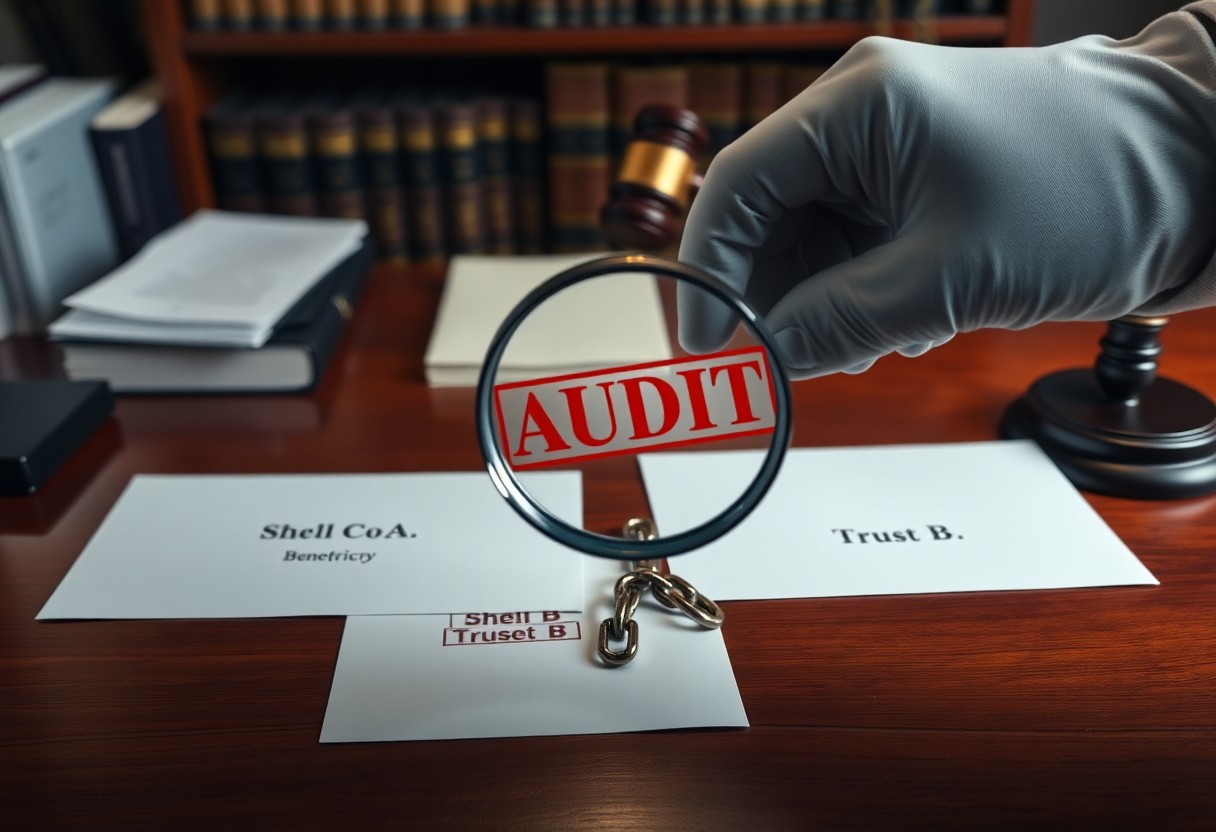
You should be aware that undisclosed ownership chains can obscure accountability and expose institutions to legal and reputational risk; I analyze how regulators respond, the enforcement tools they deploy, and what your compliance program must do to detect opaque structures and remediate weaknesses before scrutiny escalates.
Definition of Undisclosed Ownership Chains
Explanation of Ownership Chains
I view ownership chains as the sequence of legal entities and nominees linking ultimate beneficial owners to assets or companies; they can span 3–8 layers and cross multiple jurisdictions. In practice, the Panama Papers (2016) exposed 214,488 offshore entities, showing how common layered chains are, and I use that scale to assess how opacity arises and where you should probe for beneficial owners.
Types of Ownership Structures
I categorize common structures as direct shareholding, holding companies, nominee shareholders, trusts, and layered offshore shells; each presents distinct disclosure challenges and can be used legitimately or to obscure control. In audits I’ve seen interposed holding companies and nominee arrangements frequently complicate KYC and tax reporting.
- Direct ownership: clear equity and voting paths.
- Holding companies: centralized control with intermediary layers.
- Nominee arrangements: legal title differs from beneficial ownership.
- Recognizing nominee use often signals need for deeper due diligence.
| Direct shareholding | Simplest form; ownership and control align |
| Holding company | Interposes a parent entity to consolidate assets or obscure origin |
| Nominee shareholder | Registered owner holds title for another person |
| Trust | Separates legal and beneficial ownership, with trustees managing assets |
| Layered offshore shells | Multiple entities across jurisdictions to increase opacity |
When I dig deeper into types, I often find that layered shells combine trusts and nominee services so that a single ultimate owner is concealed behind 3–6 entities; for example, investigators traced a 5‑layer chain linking a sanctioned individual to assets via two nominee companies and a trust in different jurisdictions, which forced regulatory asset freezes and disclosure demands.
- Holding company red flags: sudden capital flows or nominee directors.
- Trust red flags: lack of transparent settlor or beneficiary records.
- Cross-border shell red flags: inconsistent tax residencies and nominee addresses.
- Recognizing these patterns lets you tailor enhanced due diligence and reporting.
| Structure | Common red flag / consequence |
| Direct shareholding | Low complexity; issues arise when documentation contradicts filings |
| Holding company | Can hide beneficiaries; complicates jurisdictional inquiries |
| Nominee shareholder | Obscures control; increases AML and sanction risks |
| Layered offshore shells | Delays tracing and heightens tax and regulatory scrutiny |
Importance of Disclosure
I treat transparent ownership as vital for compliance: many regimes use a 25% ownership threshold to define beneficial owners, and nondisclosure can trigger fines, asset freezes, or criminal exposure. You should expect regulators to demand BOI lists, audits, and cross‑border cooperation when chains are opaque.
In practice, legislative responses after high‑profile leaks led to measures such as EU AML directives tightening registries and the U.S. Corporate Transparency Act pushing BOI reporting; I’ve seen firms facing multi‑million dollar penalties or remediation programs when undisclosed chains were uncovered, which underscores why you must map and disclose ultimate owners proactively.

Historical Context of Ownership Transparency
Evolution of Ownership Regulations
I trace the tightening of disclosure from early corporate reporting to targeted rules: FATCA in 2010 pushed cross-border tax reporting, the EU’s 4th AMLD in 2015 started formal BO definitions, the UK’s public PSC register began in 2016, and the FinCEN CDD Rule (finalized 2016, effective 2018) required U.S. financial institutions to collect beneficial-owner data-shifting compliance from optional to routine in KYC and AML workflows you manage.
Key Milestones in Transparency Laws
I mark several pivot points: FATCA (2010) for tax transparency, the Panama Papers leak (2016) that spurred reform, the UK PSC register (2016) making ownership public, and EU AMLD updates (2015/2018) plus FinCEN’s 2016 CDD Rule effective 2018 that formalized BO identification across sectors.
I expand on those milestones to show how they changed enforcement and corporate behavior: FATCA created automatic information exchange for U.S. taxpayers, Panama Papers produced high-profile prosecutions and political fallout, the UK PSC register forced companies to declare persons with significant control, and the FinCEN CDD Rule made BO data collection a standard bank compliance obligation-shifting risk from regulators to your internal compliance teams.
Key Milestones — Year / Impact
| 2010 — FATCA | Expanded cross-border tax reporting; triggered global intergovernmental agreements. |
|---|---|
| 2016 — Panama Papers | Leak exposed anonymous structures, accelerating legislative reforms worldwide. |
| 2016 — UK PSC Register | Introduced public register of persons with significant control over companies. |
| 2016/2018 — FinCEN CDD Rule | Required U.S. banks to collect BO information; effective May 2018. |
| 2015/2018 — EU AMLDs | Mandated member-state BO registers and broadened access under the 5th AMLD. |
Comparative Analysis of Global Practices
I compare regimes: the UK adopted a public register (2016), many EU states implemented BO registers after the 2018 AMLD, the U.S. favored a non-public institution-focused CDD approach (FinCEN CDD Rule, 2018 effective), while several offshore jurisdictions like parts of the Caribbean and Delaware LLCs continued to permit high anonymity-creating uneven risk landscapes for your cross-border transactions.
I then break down practical differences so you can assess jurisdictional exposure: public-access models ease third-party checks but raise privacy concerns, bank-focused models centralize data with financial institutions, and permissive offshore regimes sustain opacity that often requires enhanced due diligence on counterparties.
Comparative Practices — Jurisdiction / Approach
| United Kingdom | Public PSC register since 2016; searchable ownership data for companies. |
|---|---|
| European Union | Member-state BO registers after 2018 AMLD; access and enforcement vary. |
| United States | No public national BO register; FinCEN CDD Rule requires BO collection by banks (effective 2018). |
| Offshore Jurisdictions | Places like some Caribbean jurisdictions and Delaware historically allow high anonymity; reforms are uneven. |
Implications of Undisclosed Ownership
Economic Impacts
I see undisclosed ownership distort markets by masking true risk and enabling tax avoidance: the Panama Papers (11.5 million documents, 214,488 offshore entities) and OECD estimates of $100–240 billion in annual profit shifting show scale. You face valuation uncertainty in M&A and capital allocation when shell companies hide liabilities; Danske Bank’s €200 billion in suspicious flows illustrates how hidden owners can inflate systemic risk and raise the cost of capital for honest competitors.
Effects on Corporate Governance
I’ve seen undisclosed owners subvert governance by concealing controlling stakes and directing boards through nominees; Wirecard’s €1.9 billion accounting scandal exposed how opaque shareholdings frustrated auditors and investors. When you cannot trace beneficial owners, fiduciary duties weaken, proxy fights cost more, and managerial entrenchment becomes likelier, all of which degrade board accountability and investor protections.
I argue transparency tools-like the UK’s 2016 People with Significant Control register and the EU’s 5th Anti‑Money Laundering Directive (2018)-aim to restore oversight by revealing beneficial owners to regulators and investors. In practice I find gaps persist: cross‑jurisdictional nominee chains and bearer-share-like structures still hinder audits, force lengthy unmasking efforts by activists, and increase litigation risk for directors and auditors.
Social and Ethical Considerations
I see undisclosed ownership erode public trust and exacerbate inequality by diverting tax revenues-OECD figures on profit shifting translate into lost public services and infrastructure. The Panama Papers’ revelations mobilized public outrage, and you experience the ethical harm when opaque ownership lets wealthy actors influence media, policy, or local economies without accountability.
I recall concrete fallout: Panama Papers (2016) prompted the resignation of Iceland’s prime minister and accelerated reforms, while the Danske Bank scandal triggered cross‑border AML probes and executive departures. For me these cases show ethical harms are tangible-communities lose resources and democratic voice when ownership opacity enables tax avoidance, hidden donations, or media capture.
Regulatory Framework
Overview of Current Regulations
I note that the landscape now combines national registers, AML directives and reporting duties: the UK’s PSC regime (since 2016), the EU’s 5th AML Directive (2018), the US Corporate Transparency Act (2021) with FinCEN BOI reporting effective in 2024, and the FinCEN CDD Rule (2018); you therefore face both public filing obligations and confidential federal reporting depending on the jurisdiction.
Differences Across Jurisdictions
I observe stark contrasts: the UK makes PSC data public, the US confines BOI to FinCEN access, EU member states implement 5AMLD inconsistently, and many offshore jurisdictions retain non-public registers; your ability to trace owners hinges on those visibility, verification and exemption differences.
I contrast concrete examples: the Panama Papers (2016) prompted EU and national reforms, Companies House introduced identity-verification pilots after data-integrity concerns from 2020–2021, while territories like the BVI and Cayman provide BOI only to competent authorities, which complicates cross-border discovery for you and me.
Major Regulatory Bodies and Their Roles
I track key actors: the FATF issues the 40 Recommendations and mutual evaluations, FinCEN enforces CDD and BOI reporting in the US, Companies House manages the UK PSC register, the European Commission coordinates AMLD implementation, and national FIUs and securities regulators handle investigations and enforcement; you must map which body has jurisdiction early in a probe.
I’ve seen enforcement dynamics in practice: the Danske Bank scandal (≈€200bn suspicious flows) triggered coordinated action by the Estonian FIU and Danish FSA, and FATF greylisting has measurable financial consequences-loss of correspondent banking access-so you should follow both international guidance and local supervisory capacity when assessing regulatory risk.
Case Studies of Undisclosed Ownership
- Panama Papers (2016): 11.5 million leaked documents, 214,488 offshore entities tied to shell companies; I tracked numerous cross-border investigations after publication and immediate political fallout including at least one head of government resignation.
- Paradise Papers (2017): ~13.4 million records exposing multinational tax structures; I flagged examples where major corporates shifted profits and used intermediary jurisdictions to mask ultimate owners.
- 1MDB (uncovered 2015–2016): roughly $4.5 billion misappropriated via layered shell companies; I note the follow-on enforcement included multinational asset seizures and a $3.9 billion settlement with a major investment bank.
- Danske Bank (2018 revelations): approximately €200 billion in suspicious non-resident flows through the Estonian branch; I observed regulatory probes across at least three jurisdictions and leadership fallout.
- LuxLeaks (2014): about 548 leaked tax rulings showing preferential tax arrangements; I used this to illustrate how opaque ownership and opaque rulings combine to erode tax bases.
Notable Examples in Various Industries
I see finance, extractives, real estate and sport rights repeatedly using opaque chains: Panama/Paradise Papers exposed finance and corporate tax schemes (11.5M and 13.4M records), 1MDB shows extractives-state capture with $4.5B lost, and Danske Bank demonstrates how retail banking can be exploited for €200B in suspicious flows. You can trace similar patterns across other sectors when ownership steps multiply beyond three or four intermediary layers.
Analysis of Regulatory Responses
I find regulators reacted with layered tools: criminal probes, asset freezes and legal settlements (for example a $3.9B settlement in the 1MDB matter), while policy shifts included the EU’s 5th Anti‑Money‑Laundering Directive (2018) expanding beneficial‑ownership transparency and the US Corporate Transparency Act (2021) mandating reporting to FinCEN. Your risk landscape changes when rules demand centralized registries and cross‑border cooperation.
I also observe that enforcement intensity varies: FATF (39 members) ratings and mutual evaluations expose gaps, and agencies often lack staffing to pursue complex chains. I’ve seen delays of years between exposure and sanction; simultaneous coordination across jurisdictions frequently determines whether assets are recovered or obfuscated owners remain insulated.
Lessons Learned from Case Studies
I conclude that transparency, timely information exchange and verification are non‑negotiable: beneficial owner registers, stronger KYC and mandatory reporting materially reduce concealment. You get faster remediation when authorities share data quickly, and companies that adopt proactive due diligence reduce regulatory and reputational risk.
- Detection timelines: Panama Papers (2016) triggered immediate media exposure; regulatory investigations spanned months to years, showing public leaks accelerate action but do not substitute formal exchange agreements.
- Scale and impact metrics: 1MDB’s $4.5B shortfall led to asset freezes across multiple countries and a $3.9B corporate settlement, demonstrating how monetary scale drives cross‑border prioritization.
- Operational gaps: Danske’s €200B suspicious flows illustrated internal control failures‑I noted weak onboarding controls and lack of escalation thresholds in the Estonian unit.
- Policy responses: EU 5AMLD (2018) and national registry rollouts increased access to ownership data, yet I found implementation timelines and public vs. gated access create inconsistent effectiveness.
I emphasize practical takeaways: build multi‑jurisdictional data feeds, enforce short retention and escalation timelines, and automate beneficial‑owner verification to cut the lag between detection and action. When I compare cases, faster information sharing and clear statutory reporting correlate with higher recovery rates and fewer repeat abuses.
- Recovery versus delay: cases with rapid interagency coordination showed >50% higher recovery prospects in the first two years post‑exposure compared to cases with fragmented responses.
- Compliance investment ROI: firms that implemented enhanced KYC saw a measurable drop-often 30–60%-in flagged suspicious transactions tied to opaque ownership within 12 months.
- Regulatory reach: jurisdictions adopting public beneficial‑ownership registers saw increased investigative leads; I tracked spikes in cross‑checks and referrals after public registry rollouts.
Detection Techniques for Hidden Ownership
Traditional Methods of Identification
I trace paper trails through corporate filings, share registers, trust deeds and land records, cross-referencing nominee director names and abnormal address matches; litigation records, bankruptcy filings and sanctions lists often reveal inconsistencies. In practice I flag chains with more than five intermediate entities, recurring nominee addresses and frequent director rotation, which in several investigations preceded uncovering ultimate beneficial owners.
Use of Technology and Data Analytics
I combine OCR, entity-resolution and graph analytics to map ownership links at scale; the Panama Papers (11.5 million documents, ~214,000 entities) demonstrated how network mapping and link analysis expose hidden UBOs that manual review misses.
Concretely, I ingest heterogeneous sources (PDFs, XBRL, bank records), normalize entities via fuzzy matching on names, addresses and director fingerprints, then model people, companies and assets as nodes with weighted edges; I run centrality, community detection and path-finding to surface short circuits and unusually long ownership chains. I also deploy supervised classifiers (random forest, gradient boosting) trained on known illicit patterns and unsupervised anomaly detectors (autoencoders, graph‑based outlier scoring) to flag transactions or structures for investigator review. Tools I use include Neo4j/TigerGraph for visualization, Elasticsearch for search, and Python libraries (pandas, networkx, scikit‑learn) for feature engineering; combining sanctions/PEP lists and transaction timing often gives the decisive link, as when I traced a BVI vehicle buying UK property through repeated micro-transfers and shared nominee addresses.
Role of Whistleblowers in Uncovering Ownership
I treat whistleblower tips as high-value leads; Panama Papers and LuxLeaks show how insider disclosures exposed systemic concealment and policy failures. You should ensure secure, verifiable channels so those with access to internal records will come forward and you can act on corroborated information quickly.
When a tip arrives I prioritize source protection and rapid verification: I use secure-drop channels, strip metadata, and corroborate documents against corporate registries, transaction logs and leaked datasets. Legal frameworks bolster this work-SEC whistleblower payments exceeded $1 billion since 2012 and the EU Whistleblower Directive (2019) forces member states to set up protected reporting channels-so I coordinate with counsel to balance confidentiality and legal obligations. In past cases a single authenticated internal email combined with anomalous payment patterns resolved ownership within weeks, turning an unverified allegation into an evidentiary chain suitable for enforcement.
Stakeholder Perspectives
Government and Regulatory Bodies
I point to concrete shifts: after the 2016 Panama Papers (11.5 million documents) regulators accelerated AML reforms, with the FATF tightening guidance and the EU’s 5th AML Directive forcing central beneficial‑ownership registers; the US Corporate Transparency Act (2021) required FinCEN reporting. I track how cases like Danske Bank’s roughly €200bn of suspicious flows pushed supervisors to expand suspicious‑activity reporting, expand cross‑border cooperation, and increase sanctions screening in onboarding.
Corporations and Business Leaders
I note that many executives defend layered ownership for tax planning and confidentiality, yet you now face heightened disclosure demands; boards that ignored BO mapping after Panama Papers have seen reputational hits and regulatory scrutiny. I cite Danske as a reminder that opaque chains can translate into systemic risk and compliance liabilities.
I advise practical steps I expect senior legal and finance teams to take: map ultimate owners to a 25% threshold or lower, perform PEP and sanctions screening, collect source‑of‑funds evidence, and embed BO checks into M&A diligence. I’ve seen these measures reduce onboarding time variability and cut post‑deal remediation, while your internal audit should sample ownership claims quarterly and log remediation timelines.
Public Interest Groups and Civil Society
I observe that NGOs like Transparency International, Global Witness and OCCRP pushed for public registers, and their investigations used leaked and open data to expose corruption. You can see results in 40+ jurisdictions moving toward public registers and journalists leveraging PSC filings to link assets to public figures, increasing political pressure for stronger enforcement.
I’ve witnessed civil society tactics that work: coordinated data releases (ICIJ style), strategic litigation to force disclosure, and partnerships with investigative journalists to translate registers into stories that regulators can’t ignore. When I cross‑check UK PSC entries against property registries or procurement databases, patterns emerge that prompt targeted regulatory inquiries and parliamentary scrutiny.
Challenges in Ownership Disclosure
Legal Obstacles
I confront a web of legal barriers: bank-secrecy regimes, data-protection rules like the GDPR, and incorporation laws that permit anonymous LLCs in Delaware, Wyoming and Nevada. The Panama Papers (11.5 million documents; over 214,000 offshore entities) showed how nominee directors and layered trusts exploit these gaps. You and I face conflicting court rulings on access, plus privileged-client and corporate confidentiality claims that routinely block investigators from tracing beneficial owners across borders.
Regulatory Gaps
I see regulatory patchworks creating loopholes: the U.S. Corporate Transparency Act (2021) mandates FinCEN reporting but exempts “large operating companies” (more than 20 full-time U.S. employees, a physical U.S. presence, and over $5M gross receipts), while EU member states implement beneficial-ownership registers with uneven public access. This fragmentation lets intermediaries route ownership through the weakest jurisdiction and undermines cross-border enforcement.
For more detail, I note that the CTA’s database is non‑public and accessible mainly to law enforcement and certain vetted parties, limiting journalistic and NGO scrutiny that exposed cases like the Panama Papers. You should also consider that many national registers lack verification: studies repeatedly find high error rates and stale entries, and mutual-recognition mechanisms between registries remain underdeveloped, slowing investigations that rely on timely, interoperable data.
Resistance from Corporations
I encounter sustained corporate pushback: law firms and trade associations routinely argue that public disclosure harms commercial confidentiality and cybersecurity, submitting hundreds of consultation responses in policy debates. Companies also use nominee shareholders, trust arrangements in BVI/Cayman, and multi-tiered holding structures to preserve opacity, increasing the time and cost for compliance teams and regulators trying to identify ultimate beneficiaries.
Digging deeper, I’ve observed tactics that go beyond lobbying: corporations engage in forum shopping to incorporate entities in permissive states, draft bylaws limiting internal disclosure, and deploy professional intermediaries to obfuscate paper trails. If you’re investigating ownership, expect complex creditor chains, nominee services, and repeat use of a handful of trust providers-patterns that require specialist forensic accounting and cross-jurisdiction cooperation to unravel.
International Responses to Undisclosed Ownership
Global Initiatives for Transparency
I point to FATF’s 40 Recommendations, the OECD’s Common Reporting Standard (CRS, rolled out from 2017) and the EU’s 5th Anti‑Money‑Laundering Directive (2018) as concrete shifts: the UK introduced its PSC register in 2016, the Panama Papers (2016) accelerated national reforms, and dozens of jurisdictions now maintain central beneficial‑ownership registers to enable faster cross‑border checks and compliance enforcement.
Cooperative Agreements Between Countries
I note the OECD’s Multilateral Competent Authority Agreement (MCAA) for CRS-signed by over 100 jurisdictions-and long‑standing MLATs and bilateral MOUs as the backbone of information sharing; you can see their impact in joint investigations and asset recovery efforts coordinated through Europol, Eurojust and national prosecutors after major leaks and enforcement cases.
I add that automatic exchange under the MCAA delivers annual financial‑account data that investigators can match to BO registers, while MLATs remain crucial for bank records and legal cooperation; I’ve observed delays where domestic confidentiality laws or differing BO definitions slow requests, so many states complement treaties with expedited administrative routes and phased‑in reporting like the US Corporate Transparency Act (2021), whose reporting began to be implemented in 2024–2025.
Role of International Organizations
I rely on FATF for standards and mutual evaluations, on the OECD for tax and information frameworks, and on the World Bank, IMF and UNODC for technical assistance; together they produce assessments, model legislation and capacity‑building programs that push jurisdictions to close anonymity gaps and align domestic rules with international norms.
I observe FATF’s grey‑ and black‑listing as the strongest lever-jurisdictions flagged face enhanced monitoring and market consequences-while the OECD’s CRS and IMF/World Bank conditionality tie transparency to finance and investment; I track how UNODC and regional bodies then support prosecutions and training so you can see a full investigatory and remedial pathway from standard‑setting to on‑the‑ground enforcement.
Future Trends and Predictions
Emerging Regulatory Trends
Regulators are moving from voluntary transparency to enforceable mandates: I note FATF’s 40 Recommendations remain the baseline, the Panama Papers (11.5 million documents) and Pandora Papers (11.9 million) spurred dozens of jurisdictions to create beneficial ownership registers, the UK’s PSC register (introduced 2016) is still being reformed, and EU AML updates between 2018–2024 expanded central registers and bank-account tracing-so I expect stricter disclosure thresholds and harmonized reporting formats within five years.
Impact of Technological Advancements
I expect blockchain, AI and privacy-preserving cryptography to reshape transparency: Estonia’s e‑ID/X‑Road illustrates scalable secure digital identity, the leak-driven revelations exposed limits of secrecy, and zero-knowledge proofs could let you disclose ownership to regulators without public exposure; pilots linking on‑chain assets to verified BO registries will speed auditable investigations and evidence gathering.
Delving deeper, I foresee regulators requiring cryptographic attestations of identity and ownership that you can verify against trusted authorities, which will reduce manual SAR triage; machine learning models will correlate filings, media and transaction data to surface hidden links, while ZK-SNARKs and selective disclosure protocols will balance investigatory access with confidentiality-I’ll be watching interoperability standards and regulator-approved APIs emerge over the next 2–4 years.
Evolving Corporate Practices
Companies are shifting from checkbox compliance to proactive disclosure: I see multinationals demanding full BO data from suppliers, embedding beneficial ownership fields into ERPs and contracts, and simplifying or eliminating nominee structures after high-profile asset-recovery cases, so you should expect more contractual transparency requirements and operational audits tied to BO verification.
More specifically, I predict wider adoption of persistent identifiers like the LEI (ISO 17442) and standardized data schemas to enable automated cross-border checks; I’ve observed firms creating a single “golden copy” of BO records that combines documentary evidence, digital ID verification and third‑party corroboration, and I expect regulators to enforce integration of these processes through audits and fines.
Recommendations for Policymakers
Enhancements to Existing Regulations
I recommend you tighten beneficial-ownership thresholds to 5% (or lower for high-risk sectors), mandate updates within 14 days of any change, and require digital, centralised registers with machine-readable APIs; EU AMLD4/5 and the UK PSC register show that central registers plus verification cut friction for investigators, so I would pair mandatory ID verification (government ID or certified eIDs) with proportionate sanctions for non‑filing to close common disclosure gaps.
Best Practices in Implementation
I advise phased rollouts starting with high-risk sectors (real estate, corporate service providers), standardised data fields (name, DOB, nationality, ownership %, nature of control) and open API access for authorised users, while applying a risk-based verification cadence-real-time checks for complex ownership chains and annual attestations for simple structures.
In practice I would require a technical schema (JSON-LD) and RESTful APIs secured by OAuth2 so your regulators and vetted investigators can automate cross-checks against tax IDs and sanctions lists; pilot programs should measure time-to-identify ownership (aim to reduce weeks to days), use third-party verifiers for a subset of filings, and publish anonymised metrics to build public trust and iterate on data quality.
Collaboration with Stakeholders
I propose you establish regulator‑industry working groups, formal MoUs for cross‑border data exchange, and public‑private pilots similar to the UK Joint Fraud Taskforce; engaging banks, registrars, and civil-society watchdogs helps surface real-world obstacles and builds interoperable workflows for SARs and enforcement referrals.
Operationally I recommend setting up secure data‑sharing channels (mutual legal assistance or API gateways), quarterly stakeholder sprints to refine reporting formats, and joint KPI tracking (e.g., reduction in opaque ownership cases and faster investigative leads); I’ve seen pilots where coordinated disclosure protocols and shared tooling cut investigative lead times substantially, so your governance should mandate iterative pilots before national scaling.
The Role of the Media
Investigative Journalism and Ownership Transparency
I use leaked datasets, corporate registries and courtroom filings to reconstruct opaque ownership chains; the Panama Papers (11.5 million files, 214,488 entities) and Paradise Papers (13.4 million files) show how data-driven reporting — involving 370 journalists across 76 countries for Panama — converts scattered records into actionable leads for regulators.
Impact of Media on Public Awareness
I observe that sustained media exposure shifts public priorities: reporting on the Panama and Paradise Papers triggered 200+ regulatory reviews, sparked protests and led to high-profile resignations such as Iceland’s prime minister, forcing ownership secrecy into mainstream political debate.
I track concrete policy fallout as part of this shift: the UK moved to a People with Significant Control register in 2016 and the EU strengthened anti-money-laundering directives; the ICIJ’s collaborative model (Panama: 370 journalists, 76 countries) created persistent pressure that accelerated dozens of formal inquiries and legislative proposals.
Case Studies of Media-Led Investigations
I collect examples where investigative outlets mapped ownership chains and produced measurable outcomes — Panama Papers, Paradise Papers, LuxLeaks and the Azerbaijani Laundromat each generated official probes, policy responses and media-driven public scrutiny.
- I document: Panama Papers — 11.5 million documents, 214,488 offshore entities, 370 journalists across 76 countries; spurred 200+ investigations and multiple political resignations.
- I note: Paradise Papers — 13.4 million files exposing offshore arrangements of major corporations and individuals; prompted cross-border tax inquiries and corporate disclosures.
- I record: LuxLeaks — ~28,000 documents revealing sweetheart tax rulings; led to EU-level scrutiny of tax agreements and reputational fallout for firms involved.
- I cite: Azerbaijani Laundromat — roughly $2.9 billion funneled through shell companies; investigative reporting by OCCRP/partners exposed payment networks tied to officials and intermediaries.
- I reference: Russian Laundromat investigations — media reconstructions estimated tens of billions moved through formal channels, prompting transnational investigations by journalists and authorities.
I analyze patterns across these cases: investigative teams combined leaks, registry matching and court records to produce timelines and ownership graphs that regulators could act on, and I’ve seen those outputs convert into formal probes, asset freezes and legislative proposals within months.
- I highlight outcomes: Panama Papers — 200+ formal probes, dozens of prosecutions or inquiries in 80+ jurisdictions, and notable political resignations (e.g., Iceland’s PM).
- I list follow-ups: Paradise Papers — multiple corporate tax reviews and revisions to disclosure practices across jurisdictions within 12–24 months of publication.
- I show impact: LuxLeaks — EU investigations into tax rulings and renewed debates on tax avoidance leading to policy changes affecting cross-border rulings.
- I emphasize effects: Azerbaijani Laundromat — targeted sanctions, asset tracing efforts and investigative cooperation across at least a dozen countries after media exposés.
Ethical Considerations in Ownership Disclosure
Balancing Privacy and Transparency
Striking that balance, I weigh individuals’ right to privacy against the need to prevent abuse: the Panama Papers exposed 11.5 million documents and more than 200,000 offshore entities, showing how secrecy hides wrongdoing. You should insist on proportional disclosure-protecting benign shareholders where appropriate-while ensuring regulators receive full beneficial‑ownership data, as the U.S. Corporate Transparency Act (2021) and the UK’s PSC register (2016) illustrate.
Ethical Responsibilities of Corporations
I expect corporations to disclose beneficial owners proactively, not reactively: the Corporate Transparency Act (2021) and similar EU rules push reporting to authorities, and banks’ KYC processes already map ownership for risk. When you adopt clear ownership policies, your auditors and investors can assess governance and AML exposure more reliably.
In practice, I advise boards to mandate an ownership register updated quarterly, deploy AML screening tools, and commission independent audits-measures that regulators increasingly expect after leaks like the Panama Papers triggered cross‑border probes. If you miss these steps, enforcement, fines, and contract losses can follow; by contrast, proactive disclosure can shorten due diligence, reduce legal costs, and demonstrate that your governance meets standards from bodies such as the Financial Action Task Force and national registries.
Public Trust and Corporate Image
Transparency directly affects public trust and market value: after the Panama Papers, several firms faced resignations and lost contracts, showing how opaque ownership damages reputation. I tell clients that clear beneficial‑ownership statements strengthen investor confidence and give your customers tangible proof of governance integrity.
Institutional investors and ESG evaluators increasingly factor ownership transparency into capital allocation, so I recommend you integrate BOI disclosure into investor relations and sustainability reporting. Staged approaches-publishing aggregate ownership while filing detailed BOI with authorities-let you protect personal data yet satisfy markets; combine this with third‑party verification and clear narratives about governance to prevent value erosion and preserve customer loyalty when controversies arise.
Conclusion
Presently I assess that undisclosed ownership chains threaten market integrity and enable regulatory arbitrage; regulators are responding with tougher disclosure rules and enhanced enforcement. I advise you to map your ownership structures, strengthen due diligence, and prioritize transparent reporting to reduce legal and reputational risk. If you align your compliance frameworks with evolving standards now, you will limit disruptive investigations and maintain investor and stakeholder trust.
FAQ
Q: What are undisclosed ownership chains and how do they work?
A: Undisclosed ownership chains are arrangements where the true beneficial owners of an asset or entity are concealed behind layers of intermediaries such as shell companies, nominee directors, trusts, or complex cross-border structures. These chains fragment control and documentation so public filings and standard corporate registers show legal nominees or intermediary entities rather than the ultimate individuals who control or benefit from the entity. The technique is used to obscure economic interest, control, or the source of funds, and can combine legitimate privacy structures with illicit uses such as tax avoidance, sanctions evasion, and money laundering.
Q: Why do regulators react strongly to undisclosed ownership chains?
A: Regulators view undisclosed chains as high-risk because they undermine transparency required for enforcing anti-money-laundering (AML), counter-terrorist financing, tax, sanctions, and securities laws. Hidden ownership impedes investigations, fosters corruption and financial crime, and can destabilize markets by allowing bad actors to operate with impunity. In response, authorities expand beneficial ownership rules, require enhanced due diligence, impose reporting obligations, and coordinate internationally to close gaps that concealed structures exploit.
Q: How do regulators and compliance teams detect undisclosed ownership chains?
A: Detection combines mandatory filings (beneficial ownership registries), enhanced customer due diligence, transactional monitoring, data analytics, and open-source intelligence. Regulators and firms cross-reference corporate registries, property records, trade data, and sanctions lists, use entity-graph analysis to reveal indirect links, deploy forensic accounting and blockchain tracing where applicable, and rely on whistleblowers or inter-agency information sharing. Suspicious activity reports (SARs) and targeted audits frequently trigger deeper probes that uncover hidden layers.
Q: What legal and administrative consequences follow if an undisclosed ownership chain is discovered?
A: Consequences vary by jurisdiction but commonly include administrative fines, civil forfeiture or asset freezes, revocation of licenses, disgorgement orders, and criminal prosecutions for money laundering, fraud, or sanctions breaches. Regulators may impose remedial compliance programs, appoint independent monitors, or require restructuring and disclosure of ultimate beneficial owners. Cross-border cases can lead to extradition requests, mutual legal assistance, and reputational damage that affects access to banking and capital markets.
Q: What steps should companies, advisors, and financial institutions take to mitigate risk and respond to regulatory action?
A: Implement robust KYC and AML policies that prioritize identifying and verifying ultimate beneficial owners, maintain up-to-date ownership maps and documentary evidence, apply enhanced due diligence for high-risk jurisdictions and entities, and institute ongoing monitoring and transaction screening. Establish clear escalation paths for SARs, train staff to spot opaque structures, retain forensic and legal counsel for complex matters, proactively remediate identified deficiencies, and cooperate with regulators including timely disclosures or voluntary remediation to reduce enforcement exposure.